
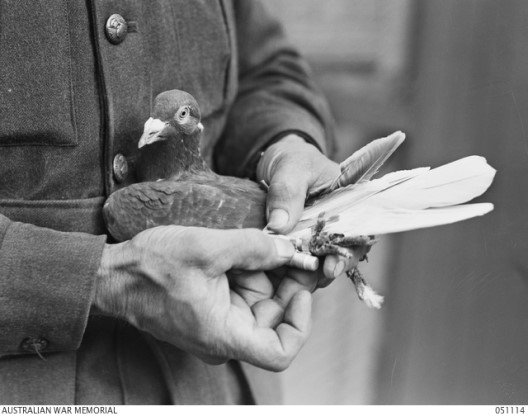
Today is Memorial Day. And on this special day we honor and mourn the U.S. military personnel who died while serving in the armed forces.
In addition to human soldiers, millions of animals have been pressed into military service throughout history, serving as beasts of burden, scouts, messengers, and combatants. The heaviest losses occurred during the World Wars, where an estimated 8 million horses and countless mules, dogs, and pigeons died from shellfire, disease, and starvation.
Carrier Pigeons in particular sustained heavy casualties. Hundreds of thousands of carrier pigeons were used to deliver life-saving messages, but many were shot down by enemy fire or killed in the line of duty.
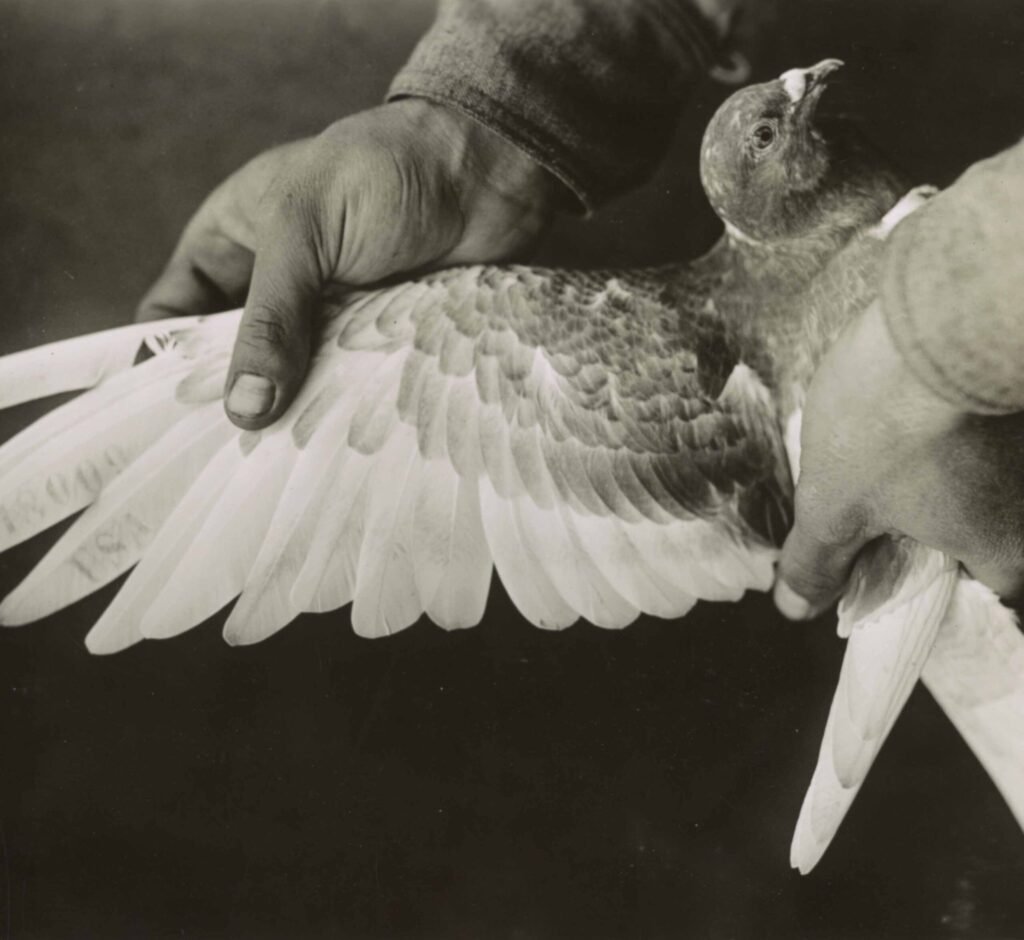
To learn more about this, a Google search directed us to a Wikipedia page that provided great background.
… carrier pigeons, are domesticated rock doves (Columba livia) selectively bred and trained to carry messages in military operations. Due to their speed, endurance, altitude, and homing ability, pigeons were frequently used as military messengers because they were often more reliable and difficult to intercept than other forms of wartime communication. Some pigeons received military honors for their service including 32 recipients of the Dickin Medal, and Cher Ami who was awarded the Croix de Guerre for delivering messages during World War I.
During World War I and World War II, carrier pigeons were used by the Australian, French, German, American, and UK forces, to transport messages back to their home coop behind the lines. When they landed, wires in the coop would sound a bell or buzzer and a soldier of the Signal Corps would know a message had arrived. The soldier would go to the coop, remove the message from the canister, and send it to its destination by telegraph, field phone, or personal messenger. Success rates for message delivery by war pigeons reportedly reached 95 percent.
A carrier pigeon’s job was dangerous. Nearby, enemy soldiers often tried to shoot down pigeons, knowing that released birds were carrying important messages. Some of these pigeons became quite famous amongst the infantrymen for whom they worked. One pigeon, named “Spike”, flew 52 missions without receiving a single wound. Another, named Cher Ami, lost his foot and one eye, but his message got through, saving a large group of surrounded American infantrymen.
Some historical points:
- Among the earliest recorded instances, the Sultan of Baghdad used message-carrying pigeons fitted with small capsules around 1150 BC, establishing one of the first known organized military pigeon networks.
- Julius Caesar used pigeons to send messages to the territory of Gaul.
- Pigeons were not widely used as official military communicators until the 20th century. During the Civil War, battlefield communications primarily relied on flags, couriers, and the newly invented telegraph, not pigeons.
- Many carrier pigeons were killed in World War I. Because battlefield communications like telephone lines were frequently severed and radio signals were easily intercepted, militaries relied heavily on homing pigeons to deliver vital messages. Because these birds were so effective, opposing forces—particularly German machine gunners—were specifically trained to spot and shoot them down. While exact total casualty numbers are difficult to track, hundreds of carrier pigeons were shot, gassed, or killed by artillery alongside other military animals. On Cher Ami’s final mission in October 1918, he delivered a message over 25 miles (40 km) despite having been shot through the breast or wing. The crucial message, found in the capsule hanging from a ligament of his shattered leg, saved 194 US soldiers of the 77th Infantry Division’s “Lost Battalion” in the Battle of the Argonne, in October 1918. When Cher Ami died, he was mounted and is part of the permanent exhibit at the National Museum of American History of the Smithsonian Institution.
- Thousands of carrier pigeons were killed during World War II. Over 200,000 homing pigeons were utilized by the Allied forces alone. Because they were vital for transmitting secret messages and calling in rescues, enemy troops actively targeted them with gunfire, falcons, and anti-aircraft artillery.While thousands of birds were lost to enemy fire, weather, or predators, many more survived severe injuries to complete their missions. Their incredible success rate (estimated around 95%) and bravery saved countless human lives.
To read more about the heroic efforts of Carrier Pigeons, you may like to read this article from The Army Historical Foundation.
Images: Department of Veterans Affairs and Library of Congress