
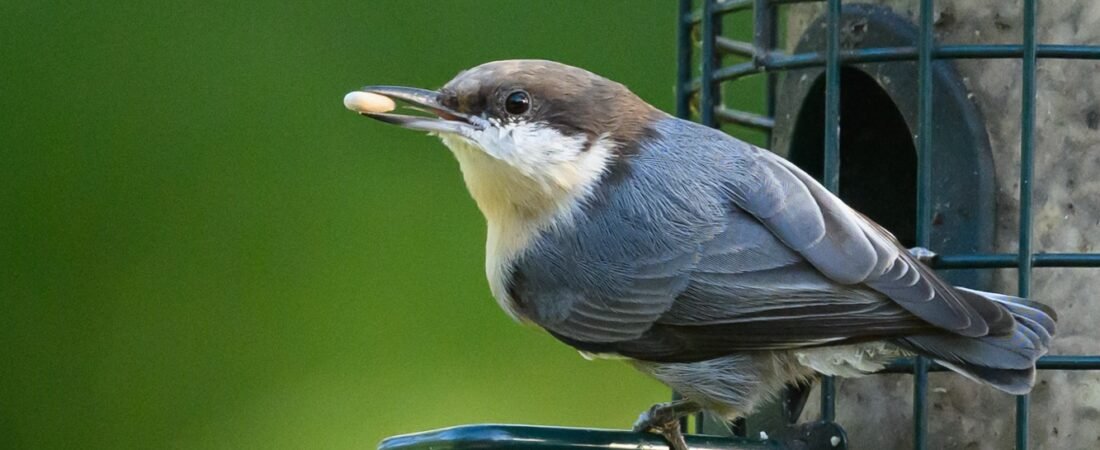
Brown-headed Nuthatches are one of my favorite birds. I can’t help but smile every time I hear one, they sound like little squeaky toys! I usually hear them coming before I see them at the feeder, they land near the top of the feeder and hop down head-first to grab a seed, then immediately fly back to the trees.
Finding a Brown-headed Nuthatch means heading to the right place—a mature pine forest in the Southeast with an open understory, or as in our case, a backyard with feeders and nearby pines. These tiny blue-gray songbirds zigzag their way up and down tree trunks and branches, squeaking as they go. They cling to bark with their strong feet rather than leaning on their tails like a woodpecker. Tool use in animals is rare, but the Brown-headed Nuthatch sometimes uses a piece of bark as a lever to pry up other bark to look for goodies below. If it finds a particularly good piece of bark it may even carry the bark tool from tree to tree or use it to cover up its stash of seeds.
Brown-headed Nuthatches primarily eat spiders and insects such as bark-dwelling cockroaches, beetle larvae, and egg cases during the warmer months. In the colder months they eat mostly pine seeds.
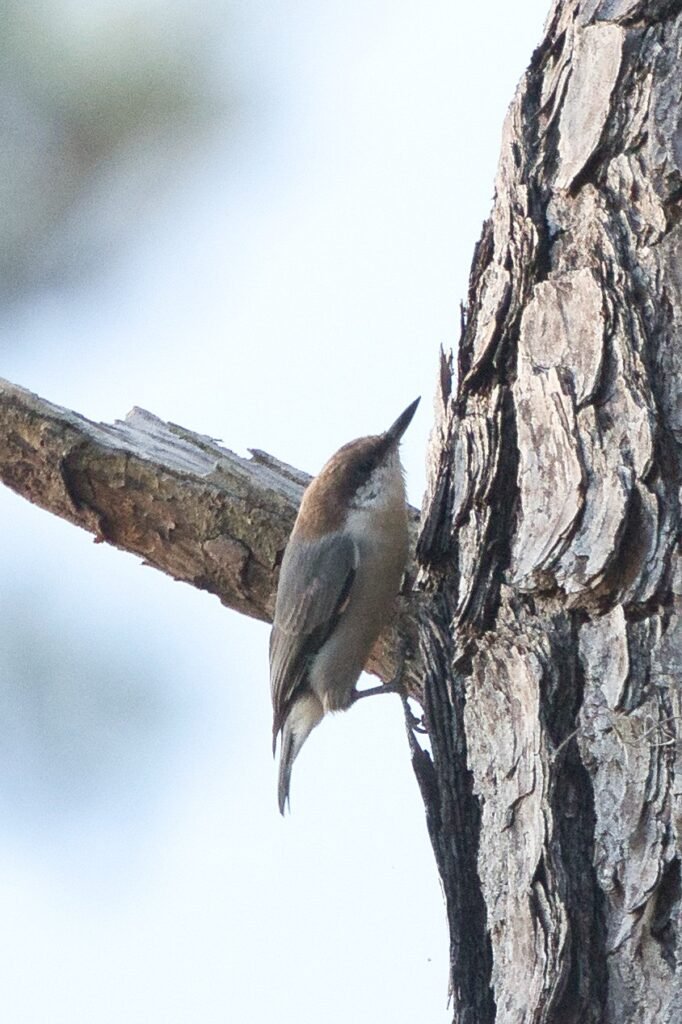
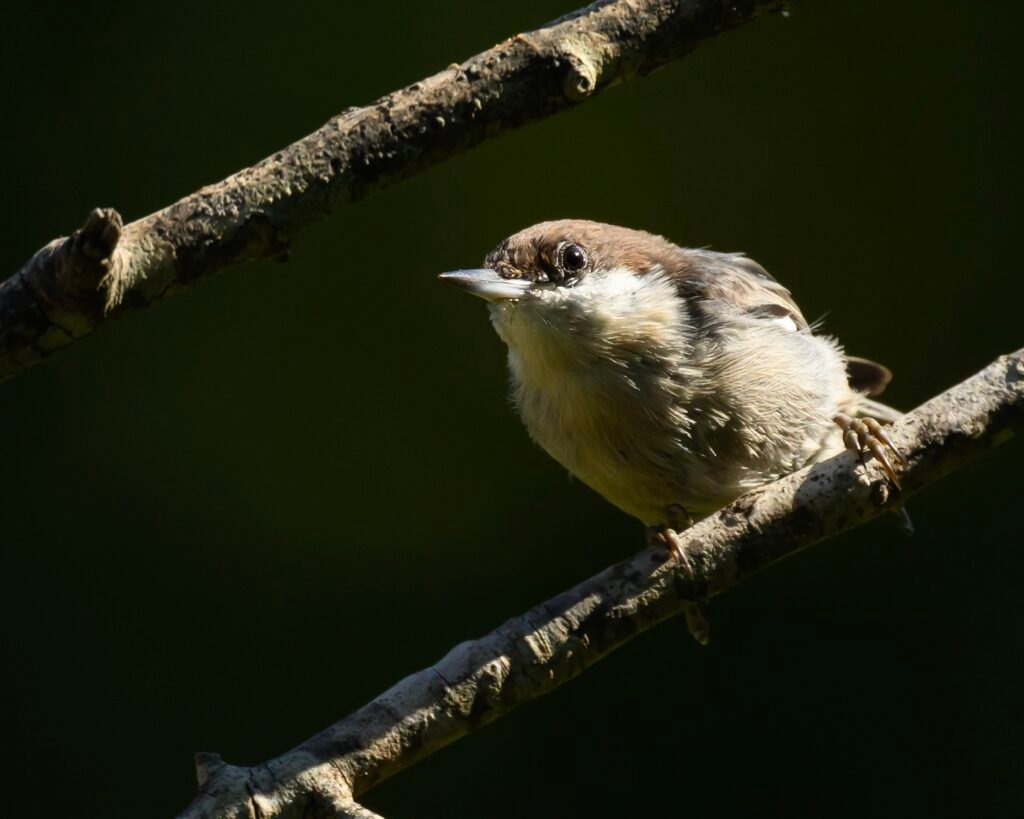
Larger than a Golden-crowned Kinglet, but smaller than a Tufted Titmouse, the Brown-headed Nuthatch is a tiny, compact little bird. It almost appears round with it’s short tail, legs and neck. They’re white below and gray above with a brown head. Finer inspection reveals a white spot on the back of the head and small white spots in the tail that are visible in flight. Males and females look similar.
Brown-headed Nuthatches are cavity nesters, with males selecting the nest location. They use existing holes in standing dead trees or excavate their own nesting hole in dead and decaying trees by pecking at the surface and rapidly flinging away the excavated material. Once they’ve completed the cavity they add feathers, cotton, pine seed wings, or bark strips to line the bottom. It takes them anywhere from 1 to 6 weeks to complete the nest depending on whether they use an existing hole or they excavate their own. The entrance to the cavity is about 1–1.5 inches in diameter. Most cavities are about 5–10 inches deep.
Males establish and maintain the bond with their mate by offering them food. Once they form pairs they often mate with the same individual for several years. Sometimes young from the previous season(s) help their parents raise offspring, a behavior known as cooperative breeding. They lay 3-7 eggs and when the nestlings hatch, they’re naked with patches of light gray down. Their eyes are closed when they hatch.
They fly weakly between trees with shallow dips, a good indication that these nuthatches don’t move long distances. In fact, they are year-round residents, and some individuals occupy the same territory year after year.
Fun Fact: Brown-headed Nuthatches are social birds. Members of the family group frequently preen each other, a behavior known as allopreening. They sit side-by-side on a branch and reach over to straighten each other’s feathers.
Source: Cornell Lab All About Birds