
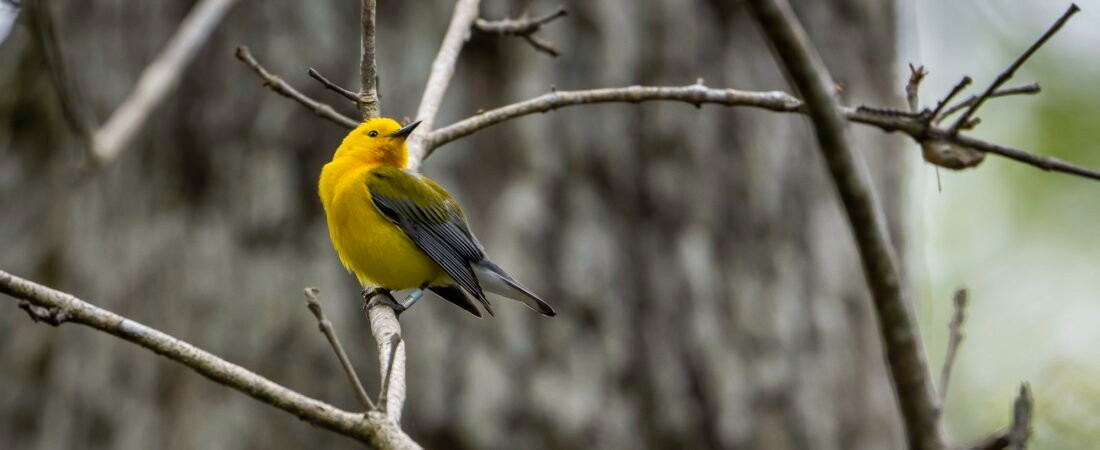
If you’ve visited any swampy woodland habitats recently you may have seen a flash of yellow darting around the trees. Prothonotary Warblers are unique among warblers as they’re one of two that build their nests in holes in standing dead trees. Often called a “swamp warbler” in the southeast, they’re also the officially designated State Migratory Bird of South Carolina.
While they are most numerous here in the Southeast, they also use forests along rivers such as the Mississippi, and can occur farther north than you might expect, even in Wisconsin and all the way north to New Hampshire along other rivers.
They tend to stay low in the forest and often forage above water and along shorelines. These bright yellow birds are conspicuous, and their loud ringing song can help guide you to them even before you see them. The best times to look for them in the U.S. are from April–July.
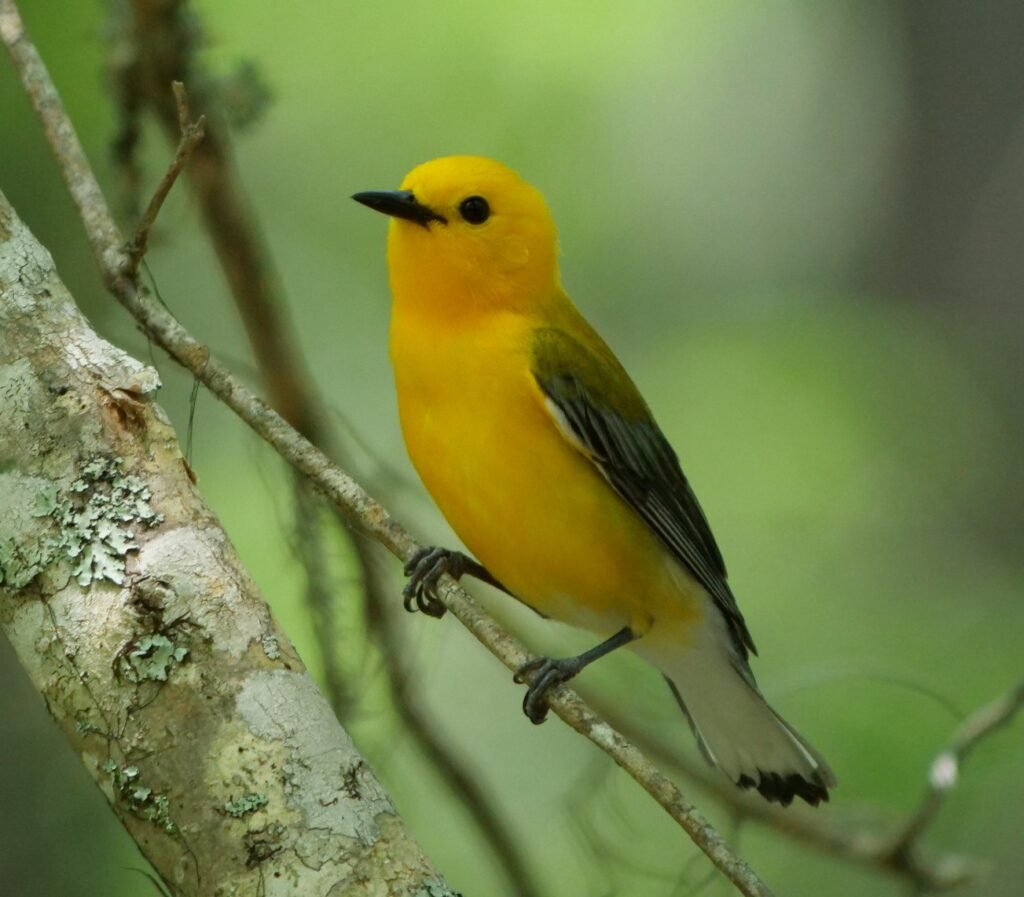
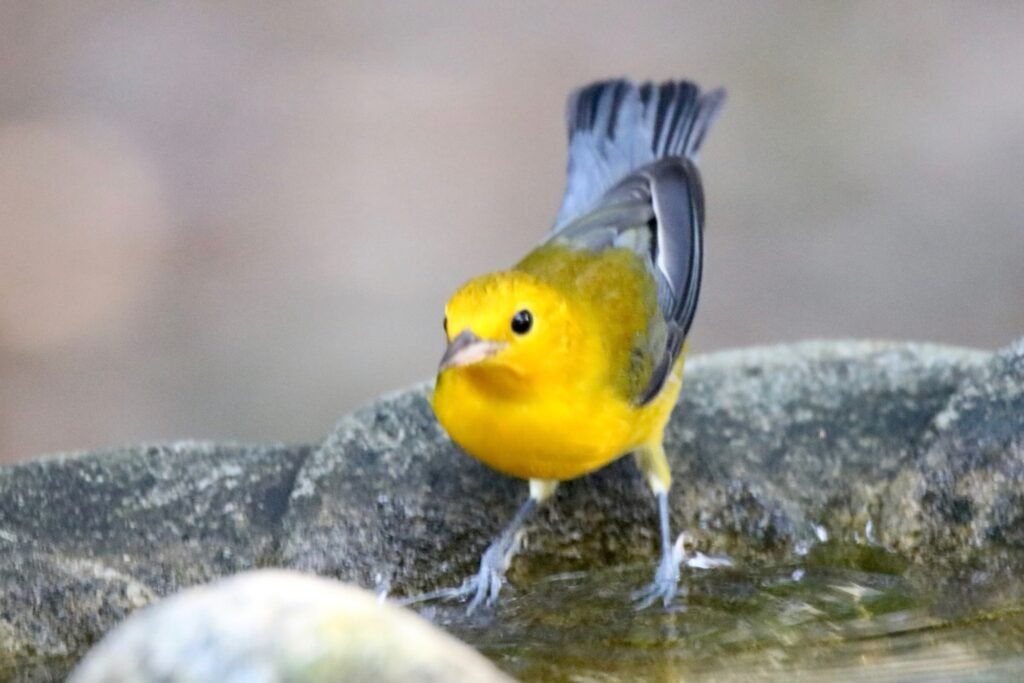
Prothonotary Warblers forage in the understory, slowly hopping along branches, twigs, and on the ground in search of food. Sometimes they climb up tree trunks and pick insects off the bark similar to the way a Black-and-White Warbler forages. They eat spiders, butterflies, moths, beetles, flies, caterpillars, mayflies, midges, grasshoppers, ants, and leafhoppers. They also eat snails and mollusks. During the non-breeding season they eat fruit and seeds in addition to insects.
When the male establishes his territory he searches for potential nesting sites in standing dead trees, typically in holes created by woodpeckers and chickadees, and he places a layer of moss in each hole. He selects a few good spots, often near or over standing water in bald cypress, willows, cypress knees, and sweetgum trees, and displays in front of each site for the female. He flies slowly up above the tree canopy with tail spread and slowly flutters back down. To entice the female to check out potential nesting sites, he enters and exits the hole several times. As soon as the female selects a site, she starts building a nest with rootlets, plant down, grape plants, cypress bark, old leaves, and even poison ivy tendrils. It takes the female 3–8 days to build a nest, and she lays anywhere from 3-7 eggs and can have 1-3 broods per nesting season.
On the breeding grounds males and females aggressively defend their territories, chasing away intruders with snaps of their bills and sometimes with physical attacks. They are monogamous and maintain their bonds during the breeding season. Occasionally they stay with the same mate the following season. They also tend to return to the same breeding site in subsequent years, especially if they successfully raised offspring at that site.
Prothonotary Warbler populations declined approximately 0.7% per year, resulting in a cumulative loss of about 31% from 1966 to 2019, according to the North American Breeding Bird Survey. Partners in Flight estimates the global breeding population at 2.1 million and rates them 14 out of 20 on the Continental Concern Score indicating a species of high conservation concern. Partners in Flight includes Prothonatary Warbler on the Yellow Watch List “D” for species with population declines that have moderate to high threats. As habitat specialists, these warblers are vulnerable to the loss and alteration of forested wetlands on their breeding grounds. Removal of standing dead trees and channeling of streams can affect availability of nest sites as well as nest success.
Locations near Seabrook Island for spotting Prothonotary Warblers include Magnolia Plantation and Gardens and Caw Caw Interpretive Center.
Source: Cornell Lab All About Birds: Prothonotary Warblers
Feature Photo by Michael Audette