
The Avian Conservation Center, located in Awendaw, SC is best summed up by its mission statement:
“To identify and address vital environmental issues by providing medical care to injured birds of prey and shorebirds, and through educational, research, and conservation initiatives.”
To that end, the Center is comprised of three operating divisions: the Center for Birds of Prey; the Avian Medical Center; and the South Carolina Oil Spill Treatment Facility. They reach all corners of South Carolina and will reach across state lines should the need arise.
It’s important to note that the first action to be taken by anyone finding an injured bird is to call the Avian Medical Center at 843-971-7474 then choose option #1. They will ask you for your exact location and the particulars regarding the situation. They need to know the type of bird (if known), your best description of the condition of the bird (whether it can walk/fly or has obvious damage), and any help that you can provide such as simply remaining on site to help the volunteer locate and capture the bird. The Center will then send out a call to its volunteer list to locate someone who is available to respond. The Center is the central point of information so it’s vital that they become involved as a first step. It’s frustrating for a volunteer to go out to capture a bird and be unable to locate it when eyes have not remained on it.
I first became aware of them from wonderful educational lectures given by the Birds of Prey staff at Seabrook Island Birders’ Club meetings. They made me aware of the need for volunteers to transport and/or capture injured birds and get them to the Avian Medical Center for treatment.
The reality of the peril for local birds was driven home to me one evening when a hawk brought down a juvenile night heron in my backyard. The heron looked stunned and in bad shape and I realized that I had no idea what to do. I watched him for a while, and he finally disappeared so I thought that he had recovered. However, the next morning his dead body was lying on my deck. I have no idea what animal found him, but I felt tremendous guilt that I hadn’t taken any steps to help him the night before.
That gave me the impetus to contact the center and offer my services. They put me through the training to become a Transporter, and I was on my way. While you may think that transporting is a simple matter of putting a box in your car and driving to the clinic, there are very specific rules. The biggest danger for an injured bird, aside from the injury itself, is stress. Birds are wild and very uncomfortable being near humans. So, even if they are struggling, the stress and fear of human intervention can cause death. Minimal talking, minimal handling, minimal sounds, darkened areas are all recommended. When I’m driving a bird, it is kept within a conditioned space within the car covered with a towel or sheet. I never talk or play the radio, so the car is as quiet as possible.
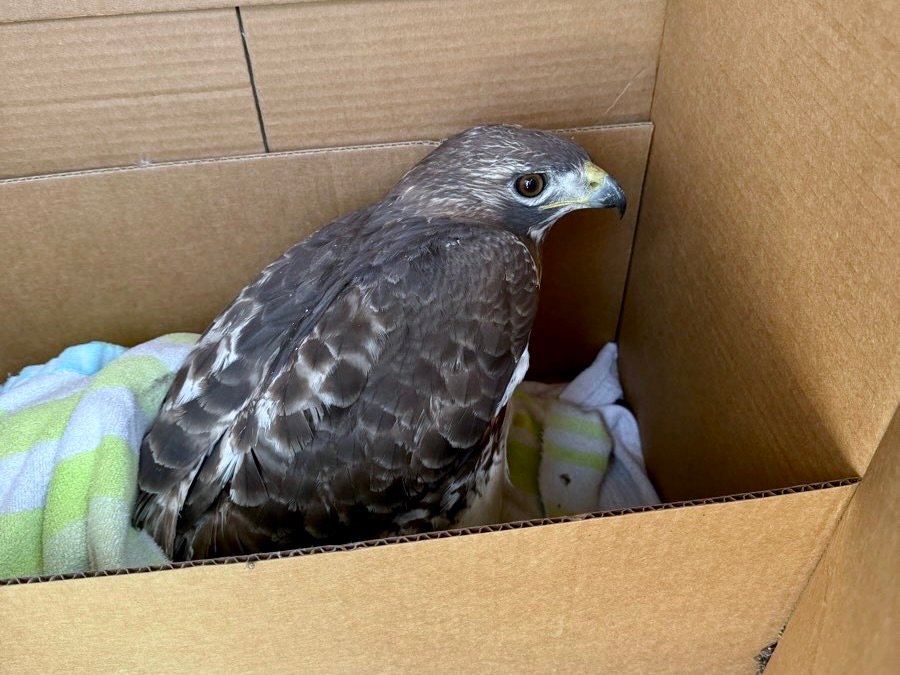
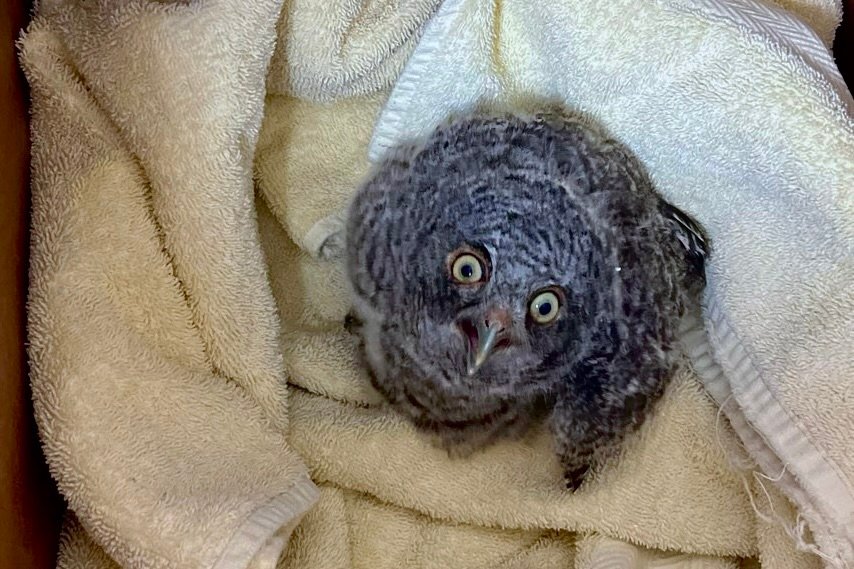
I have since had training in the capture of the various types of birds. Again, very specific instructions given for the safety of both the bird and me. For all raptors, the main worry is about the talons so getting those under control is vital although they may still try to bite when stressed. With herons, egrets, pelicans, anhingas, and such, the main worry is about that long beak and not the feet so grabbing the beak is the first order of business. They will shoot that sharp beak out at you in a heartbeat. I always have my long-sleeved welder’s gloves, eye protection, towels, sheets, and boxes in the car…just in case.
The clinic takes in birds from all over the state and even some from just out of state. South Carolina is divided up into regions, and I’m assigned to the West Charleston district. As such, I can be called upon to engage with birds from Seabrook/Kiawah, Johns Island, James Island, West Ashley, and out to Ravenel. A very typical transport for me is to meet another transporter in Ravenel who is bringing a bird up from Beaufort, Port Royal, and Savannah. I’ll take it the rest of the way to Awendaw. I’ve even had the pleasure of finding out where the heck Ruffin, SC is located so I could pick up a Great Horned Owl. Look that one up, I had to.
To give you a sense of the magnitude of the work of the clinic, here are some numbers. This past year, 2025, they treated approximately 1,125 birds. The year before was approximately 1,140 and I’ve been told that in 2023 they topped 1,200. I’ve personally transported 50 birds just from May 23 to the end of December. My extensive list includes hawks, herons, ospreys, owls, loons, pelicans, kites, vultures, rails, gulls, anhingas, bald eagles, and cormorants. So, you can see that it is quite a selection of birds that need attention.
The medical team at the clinic always impresses me with their dedication, knowledge, and skill. They are nice enough to humor me and allow me to come into the back examination room and watch and learn as they do their thing attending to the bird that I’ve brought in. The range of injuries is wide. Broken or dislocated wings, ingestion of poisons such as rodenticide, damaged legs, lead toxicity from gun pellets and fishing weights, eye infections, neurological damage from vehicle collisions and window strikes, entanglement in fishing lines, landscape, and other netting, electrical power lines, and general cuts and bruises are among the list.
The team calmly go about their business diagnosing and determining the best course of action. Most birds get x-rays for diagnosis and, later in treatment, to assess progress. The birds need to be anesthetized so they can take proper x-rays to get an accurate picture of the problem. Sadly, they also have the experience to know if the injury is of a type that can’t be repaired and humanely euthanize the patient. Those birds who are candidates for a successful recovery begin their treatment regimen which can take days or, more likely, weeks. It’s sometimes determined that recovery is possible but release back into the wild is not recommended. A limited number of these birds can be transferred to the Birds of Prey education center and trained under safe conditions to teach the public of the wonder of the world of raptors. Unfortunately, it’s impossible to place them all. The clinic has placed non-releasable birds at other facilities across the country. It’s an arduous process through layers of federal and state laws that are required to meet standards of placement. The receiving facility must meet permitting requirements and special conditions for the type of role the captive bird will serve. Sadly, some non-releasable birds must be euthanized. It’s a heart-breaking decision, especially after a great length of care.
The final steps for those birds slated for release back into the wild is a carefully monitored round of physical therapy. Birds are hospitalized indoors in critical care until they are ready for rehabilitation in the outdoor flight enclosures. There are currently four buildings, each with multiple enclosures of varying sizes and shapes. One is a flight circle, allowing for unimpeded flight especially designed to allow them to practice flying to build up their strength and stamina before again facing the dangers of the outside world.
It’s a happy day when the call goes out for a volunteer to come get a bird for release. In most cases, the birds are released back into the same area from where they were originally found. Sometimes this isn’t possible and a safe area is chosen where the odds are high that they will adapt and survive. Some birds are migratory and are released locally with the belief that their instincts will take over and send them in the correct direction to join the others.
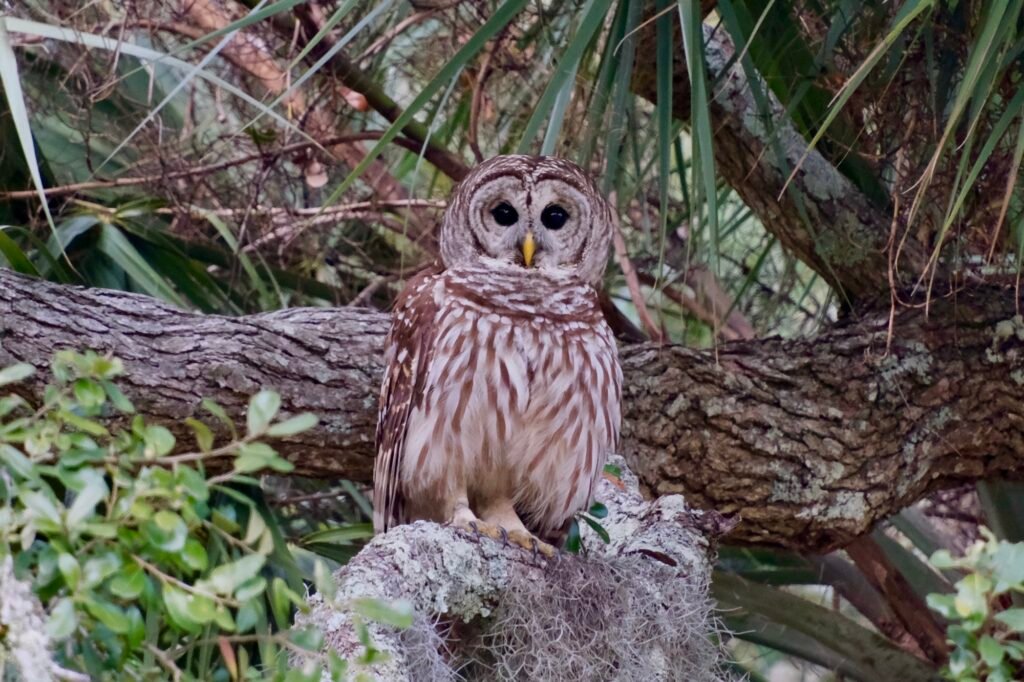
I’ve had the privilege to release five birds to date: a Red-tailed Hawk and four Barred Owls. It’s fascinating how differently each of them acted as I opened their containers. The hawk helped me open the box pushing his way out and he was gone in a flash. One of the owls didn’t waste much time being on his way but at least waited for me to fully open the box. Two of the owls let me open their boxes and just stared at me for a good five minutes or more before deciding “Okay, I guess that I’ll leave now” and calmly flew off into a nearby tree. And one owl totally perplexed me. I opened the container and he just sat looking at me. When I say that he just sat, I mean that he sat there for a good hour and a half! By then it was dark and I was at a loss to know what to do. I walked to my nearby car to consider my options and when I returned, he was gone. I guess that he just needed to know that I was out of his personal space.
But the experience has been incredibly rewarding and educational. I highly recommend it to anyone who wants to contribute their time to the valuable cause of avian conservation.
Personally speaking, I believe that I have paid my debt to that night heron in my backyard.
Written by Rick Heilman
Photos and Video by Rick Heilman
To learn more about the Avian Conservation Center, please click here.