
Jennifer Jerome and I (Judy Morr) recently joined Craig Watson and Ventures Birding for 10 days of birding in South Texas. Craig’s twin brother Keith was our second terrific guide. The 800+ miles in the van and an average of 10,000 steps a day meant there were some long days but well worth it.


Neither Jennifer nor I had birded Texas before so we knew we would get a lot of “life birds”….birds we had never seen before. We won’t bore you with a report of all 56 life birds for me or the 80 Jennifer had. We do want to share some (ok, too many) highlights.

While awaiting the hotel courtesy van in San Antonio, Jennifer posted her first life bird…a Great-tailed Grackle. Think of our Boat-tail Grackle but bigger and just as noisy. It wasn’t long before it became “just another Great-tail”. They were reported on 36 of our 48 submitted eBird checklists for the trip.


While relaxing by the pool before the official start of the tour, I finally got the White-winged Dove that has eluded me the last two years in Florida and when searching for rarities in Mount Pleasant. That checklist also had our first Swainson’s Hawk and a Crested Caracara.

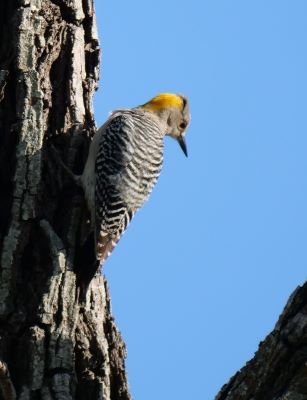
The first day of the tour took us to Mitchell Lake Audubon and Goliad State Park. 7 birds were added to our life list with the Golden-fronted Woodpecker (similar to our Red-bellied) and Ladder-backed Woodpecker (think Texas version of Downy Woodpecker) species we’d see again many times. The Black-crested Titmouse looked and sounded very similar to our Tufted Titmouse but as expected, had a blacker head. The Black-crested Titmouse was one of many species who moved too quickly to be captured in photos.
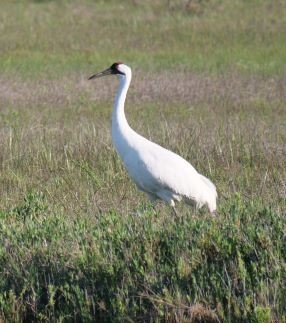

At Aransas National Wildlife Refuge we got our first glimpse of the huge Whooping Cranes. We had a closer view of them from our cruise on the intracoastal waterway where we also saw a rookery of nesting Great Blue Herons and Caspian Terns. Along the way, we also had good comparisons of our Double-crested Cormorants to the smaller Neotropic Cormorant.


At the Goose Island State Park, we got our first view of Long-billed Curlew. We were happy to also see 35 familiar species such as Laughing Gulls, Least Sandpipers and Piping Plovers.


As we passed through Corpus Christi, we had to “chase” the rare Cattle Tyrant. It wasn’t much of a chase as this Mexican flycatcher has been hanging out at an oyster shell recycling bin since November, enjoying the nearby flies. Bob and Eileen Mercer later detoured to the same location on their way to the eclipse and saw it on the same dumpster.


A rest area stop got our first sighting of the Hooded Oriole. Later in the trip we also saw the Altamira Oriole, Bullock’s Oriole and Audubon’s Oriole. Although we often saw the Hooded Oriole, it will always be a rest stop bird for me.


In Brownsville, we saw the Olive Sparrow, Buff-bellied Hummingbird and the gorgeous Green Jay. At sunset we were at a municipal park to see Red-crowned Parrots, Lilac-crowned Parrots, and White-fronted Parrots come into roost for the night. Unfortunately, the lighting was too poor for pictures.
To give us a chance to see the Apl0mado Falcon, Craig skillfully drove down deeply rutted roads. We had almost given up on the bird when a fellow birder we met along the way texted Keith that the bird was back. We saw it….perched high on the cell phone tower.


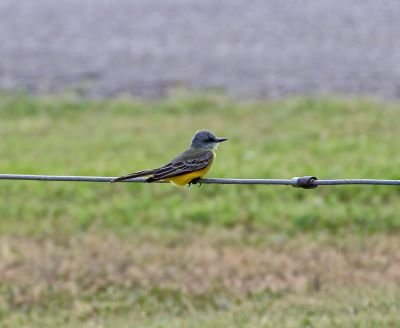
Several of our 48 eBird lists included the trio of colorful yellow birds….Couch’s Kingbird, Tropical Kingbird and Great Kiskadee.

From Brownsville to Laredo, Texas, we often kept two check lists at each stop. One for birds seen on the US side of the Rio Grande and a Mexican checklist for those seen across the river. All along this stretch, there was a very visible presence of border patrol. As we were birding Santa Ana NWR, two officers rode through on their bikes. In Laredo, an air boat sped by. Other places we saw cameras hidden in trees or on poles, following our movements. Several times we were birding on the US side of the border but Verizon kept giving us “Welcome to Mexico” messages. It wasn’t unusual for our servers to speak limited English and none of us were comfortable with our Spanish. We were able to communicate enough to get some great meals.

McAllen, Texas is an area where a week could easily be spent at nearby hot spots. At Santa Ana NWR, we got a better view of the juvenile White-faced Ibis that looked a lot like our Glossy Ibis but its red eye distinguished the species (plus there are no Glossy Ibis in Texas). One evening we went to Bentsen State Park at dusk to watch an adorable Elf Owl come out of its telephone pole home for its evening rounds. We also heard the Common Pauraque which sounded similar to our Chucks-will-widow. This was one of the areas where we birded between the wall and the river.

After leaving McAllen we headed through Roma to Falcon Lake and on to Zapata. Along this route I saw my first Greater Roadrunner. On the same dirt road we saw our first Black-throated Sparrow. When you have 10 birders in a van, eyes and ears are always looking for birds. The Hooded Oriole at a rest stop, a Harris Hawk perched on telephone pole on the way to Aransas NWR, and a Lesser Nighthawk circling the lights at a convenient store on the way back to the hotel from dinner. Scissor-tailed Flycatchers were beautiful birds we reported on 16 separate checklists. We saw them more often but didn’t report each sighting.


The Green Parakeet was seen in our hotel parking lot in Brownsville. While loading the van one morning, we got our first glimpse (33 individuals) of Chihuahuan Raven. Our only report of the Common Raven was at Lost Maples State Natural Area (SNA) where we only saw two. One was in a nest on the side of a cliff which made it a special occasion.


A Pyrrhuloxia (very similar to our Northern Cardinal but with a yellow bill) was first seen on the dirt road with the Greater Roadrunner. Both were later seen with better views at state parks and RV campgrounds. One of Jennifer’s favorite “life birds” was the Plain Chachalaca…possibly because they reminded her of Wild Turkeys which she is always happy to see in South Carolina. The RV park was where we got the best view of both male and female Vermillion Flycatcher.


One of the more elusive birds we saw along the Rio Grande was the Morelet’s Seedeater. We finally saw it along a ditch next to the Rio Grand in Laredo. Across the river in Mexico was a huge nest of Monk Parakeets.

Our last day we visited the hill country northwest of San Antonio. At Lost Maples SWA, I finally got the Lesser Goldfinch who were visiting the feeders. These birds were eighth on my target list of life birds I’d likely to get on the trip. It took until the last day to see them even though they had been reported on 38% of the eBird lists for March. While in the parking area, we also saw the Golden-cheeked Warbler which was one of our target birds for the day. We first heard the Canyon Wren and later got a good view in the distance. We also heard a Tropical Parula and saw our familiar Northern Parula. The Hutton’s Vireo sang nicely for us and gave us some good sightings but this bird flitted around too much to get a picture. We tried a second SWA in the area but unfortunately the Black-capped Vireo eluded us…one of several that will give us an excuse for a return visit.


Pictures don’t show the wonder of seeing a migration of hawks and vultures (at Santa Ana) or almost 2000 White Pelicans while at the sod farm looking for American Golden-Plover and Buff-breasted Sandpipers.


Yes, it was a birding tour but we also saw a few mammals worth mentioning. As we were driving through the country, we saw lots of deer. Some were in fenced areas to the extent we believe they were domesticated. At Falcon Lake, I saw my first ever Jack Rabbit. The dolphins that followed the boat in the intracoastal waterway were definitely not domesticated. The Collared Peccary at Frontera were obvious used to scavenging under the bird feeders but were still wild animals.
I saw (or heard) 210 of the 224 species on the trip report. There were many more we could have seen so another trip is a possibility but there are a lot of other places to consider…more planning to do.
Submitted by: Judy Morr
Photos by: Jennifer Jerome unless otherwise noted