
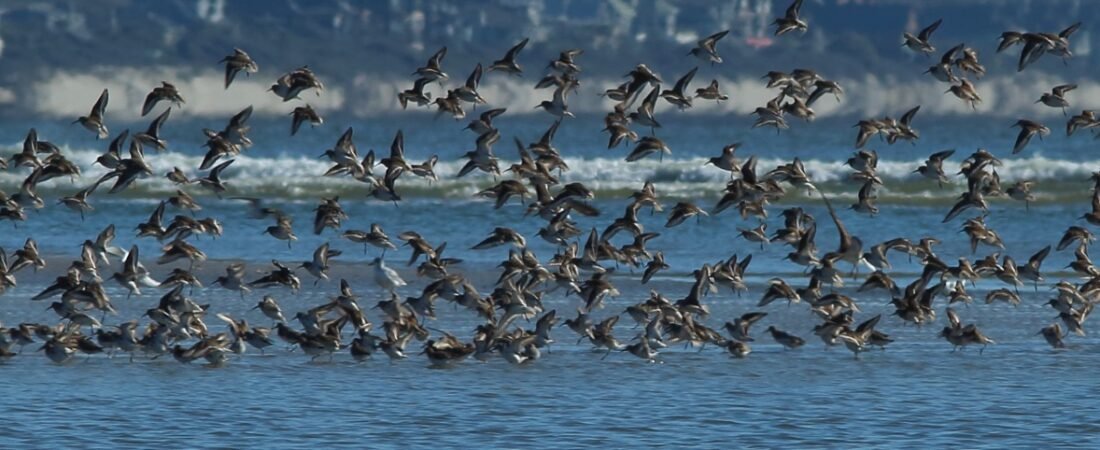
If you’ve ever walked up to the inlet during high tide in winter and noticed a large flock of birds resting in the sand, chances are you’re seeing Dunlin.
Dunlin breed in the Arctic regions of the world, but in winter are one of the most widespread shorebirds in North America, favoring coastal regions and feeding on mudflats in the falling tide.
As they rest with other shorebirds, a spotting scope can be very helpful in telling them apart. Dunlin were once called the Red-backed Sandpiper, but are now named for their non-breeding plumage, which is a mousy gray-brown or “dun” color.
At 8.5″, they’re a medium sized shorebird, about the size of a robin. Their winter plumage is a dull brownish gray. Breeding adults have a black belly and a rusty, mottled back. They also have a long, drooping bill. They’re larger than a Western Sandpiper, but smaller than a Short-billed Dowitcher.

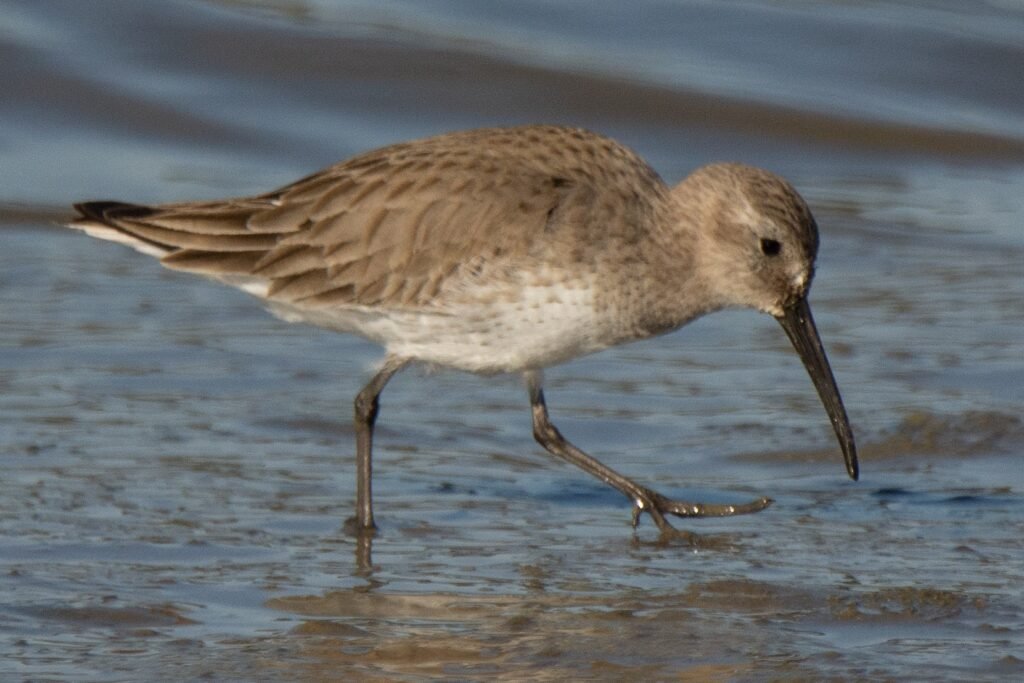
Dunlin feed by walking slowly, usually in large flocks, and picking and probing in the mud. They normally probe less than a quarter-inch deep, feeding on marine worms, midges, flies, craneflies, beetles, spiders, snails, blue mussels, small clams, and amphipods.
According to Cornell Lab All About Birds: “In spring, male Dunlin arrive on the breeding grounds ahead of females and set up nesting territories as the snow and ice melt from the tundra. They mark territories with flights and song, a burry, reverberating, descending trill unlike any other sound of the tundra. In display, they fly over the territory with rapid, fluttering wingbeats, punctuated by short glides on cupped wings. They also sometimes call and sing from the ground, raising one wing. Their territories range from 0.5 to 18 acres in size. Male Dunlin drive other males from their territories, usually by chasing them in flight, but they feed peaceably with other males in ponds outside the territory. Dunlin are largely monogamous, and both sexes incubate the eggs and defend the young.”
“Males normally select the nest site, and nests are set in tundra vegetation, often near clumps of grass. Males make several scrapes (depressions in the tundra vegetation) using their feet and breast, then sometimes line the scrape with willow leaves, sedges, and grasses. Females select the site that will serve as the actual nest. Nests average about 3.9 inches tall, with the interior 3.8 inches across and 2.5 inches deep. They raise one brood per season, with 3-4 eggs in a clutch. At hatching, the chicks are active and covered with down.”
Here’s an interesting fact: “Shorebird hybrids are very rare, but careful observation by birders have turned up hybrids between Dunlin and at least two other arctic-nesting species: White-rumped Sandpiper and Purple Sandpiper.“
Source: Cornell Lab All About Birds
Submitted by: Gina Sanders
Photos by: Bob Mercer (feature photo) and Ed Konrad