Is this a question you ask yourself (or others) when birding? It could be because you need help identifying it, it could be a senior moment, it could be that its nickname is more memorable that its official name, or it could be because its name has changed.
On November 1, the American Ornithological Society announced birds in North America will no longer be named after people. Next year, the organization will begin to rename around 80 species found in the United States and Canada.
“There is power in a name, and some English bird names have associations with the past that continue to be exclusionary and harmful today,” the organization’s president, Colleen Handel, said in a statement. “Everyone who loves and cares about birds should be able to enjoy and study them freely.”
My first thought when I read this was that this isn’t the first time bird names have been changed. A couple names I still hear and their new names readily come to mind:

Louisiana Heron – This bird is now called the Tricolored Heron. I saw one place this name change was done in 1905 but Bob Mercer mentioned his first field guide published in 1966 still referred to it as a Louisiana Heron. Sure enough, when I went to my bookshelf, I also had this edition of “A Guide to Field Identification: Birds of North America” by Robbins, Bruun, Zim and Singer. I like this specie’s new name as I can identify this heron versus a Little Blue Heron by its white belly.
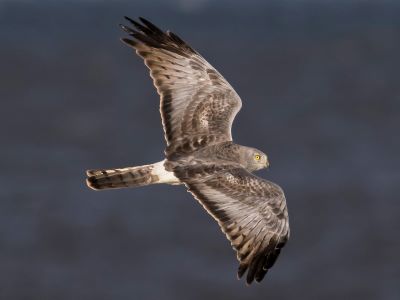
Marsh Hawk – is another name still commonly used by “seasoned” birders. The current name for this bird is Northern Harrier. It is often seen flying over the marshes around Seabrook Island sporting its distinguishing white patch at the top of its tail.

Audubon’s Warbler – This one will get really confusing. In my 1966 book, it was called Audubon’s Warbler as the Western counterpart of the Myrtle Warbler. (Note: This picture is actually a Myrtle Warbler). Wikipedia says it was 1973 when these were combined to become Yellow-rumped Warblers. “Butter butt” still seems a more appropriate name. For years I’ve heard talk of separating the two species again as Audubon and Myrtle have been retained as sub-species names. Given that Audubon is a person, I wonder what its new name will be if the species is separated again.
Nancy Brown mentioned she occasionally still uses these “old” names:
- Gray Jay – This passerine seen by Nancy in northern Maine is now known as the Canada Jay
- Common Moorhen – Birds and Bloom says it was July 2011 when this species became the Common Gallinule.

Bob Mercer, curious about the name changes since he started birding, took a quick look at the old field guide and noted the following changes. He gave up after just the waterfowl, herons, and hawks as there were so many. He noted the following: White Pelican to American White Pelican, Gannet to Northern Gannet, Blue-faced Booby to Masked Booby, Whistling Swan to Tundra Swan, Shoveler to Northern Shoveler, Fulvous Tree and Black-bellied Tree Duck to Whistling Duck, Oldsquaw to Long-tailed Duck, White-tailed Hawk to Black-shouldered Kite, Everglade Kite to Snail Kite, Pigeon Hawk to Merlin , Sparrow Hawk to American Kestrel, Common Egret (first changed to American Egret) to Great Egret. This barely touches the changes made in “recent” years.
As ornithologists learn more and more about the birds they study, the American Ornithological Society-AOS (formerly the American Ornithological Union-AOU) reviews the science that documents a changing understanding of bird relationships. This resulted in the AOS frequently shuffling bird families and names around. In the past, the many name changes were based upon scientist advocating for a clearer names. Often, as in the case of the Northern Harrier, they standardized the name for species living in multiple countries. Another example was the Common Gallinule where they changed the name to Common Moorhen because this species also is found in Europe where the Europeans called it the Common Moorhen. After years of people pointing out that here in America we have no moors and that not all of the birds are hens, they changed the name back to Common Gallinule for clarity. Other times it was because scientists discovered that birds like the Myrtle and Audubon’s Warbler were essentially a single species or a bird like the former Solitary Vireo was actually two species the western Plumbeous and our Blue-headed Vireo.
The major difference in this recent announcement is the name changes will not be made because of changing science, but of a desire to provide a descriptive name as opposed to an honorific name, many of which were bestowed upon unworthy characters. When one looks at the many honorific names, it is interesting to note that very few are female and those few, Lucy’s Warbler, Virginia’s Warbler, and Anna’s Hummingbird are always just the woman’s first name. It is committees within the AOS that will eventually propose name changes.
The intent of the planned renaming is good, but the process will take years. We will need to get used to the new names and need to buy new field guides. The plan to gradually implement the name changes will ensure a strong demand in new field guides. Meanwhile, embrace the changes and forgive each other as we use the names we originally learned.
Submitted by: Judy Morr
Pictures: Tricolored Heron: Ed Konrad; Northern Harrier: Audubon Library; Yellow-rumped Warbler: Ed Konrad; Common Gallinule: Jackie Brooks