
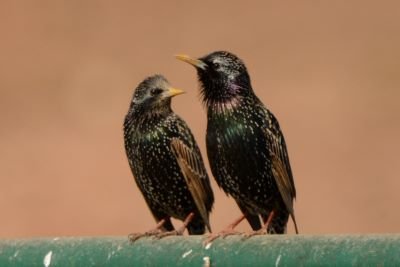
European Starlings are ubiquitous in the U.S. with an estimated population of 200 million; they are also a generally vilified species. Luckily for us, there are not many on Seabrook and they are primarily in the barn area. In my research for this article, I came across a fascinating piece that I hope you will enjoy as much as I did. It was published by Allegheny College documenting a research project by John MacNeill Miller, an assistant professor, and his student researcher, Lauren Fugate. Excerpts from that article follow.
“Starlings have become some of the most reviled birds in North America and we wanted to find out why,” says Miller. (They) “are viewed as not only an invasive species, bullying other birds around feeders and nesting holes, but also as agricultural pests, causing $1.6 billion in damage to fruit and grain crops and spreading disease….The hatred toward starlings seems to be rooted in longstanding cultural prejudices rather than in actual facts about them.”
It is true that common starlings are not native to North America, and that many scientists, birders, and environmentalists don’t like them. But when Americans first imported starlings from Europe in the 1800s, they did so with a very welcoming and experimental spirit.
By the early 1900s, starlings had definitively established themselves in North America — and attitudes began to turn against them. “But those attitudes had little to do with any biological or ecological problems caused by the starlings themselves, and a lot more to do with growing anti-immigration attitudes in the U.S. — attitudes that extended to nonhuman species,” Miller says, ”You can see this in the very political language casting starlings as foreign invaders that appears regularly after the turn of the 20th century.”
Fugate’s research found that as dislike of the birds grew, so did a new theory about how they got here. According to that rumor, starlings were imported by a misguided Shakespeare fanatic, a well-to-do entrepreneur… who was obsessed with introducing into North America every bird mentioned in Shakespeare.
“That story is essentially fiction, but it did a lot to color how people saw starlings in the 20th century,” Miller says. “I wish I could say we all approach starlings more neutrally and evenhandedly now. Unfortunately, those older attitudes and language are still in circulation today, often in supposedly scientific discussions of starlings as examples of non-native, ‘invasive’ species.”
The moral of the history unearthed by Miller and Fugate is that “we never see nature with fresh, pure, objective eyes. We see it through the selective vision of our cultural beliefs and values. That’s actually a good thing, because it’s what enables us to have meaningful, enriching relationships to the animals and plants around us. But being aware of our selective vision—of the way even nature is accessible to us only through the medium of culture—should also keep us humble. It should remind us to be wary of perceived certainties about which animals and plants around us are ‘good’ and which are ‘bad.’ It should keep us curious and open-minded about the value of creatures we’ve been taught to write off as uninteresting or even insidious. Starlings probably aren’t the only pest species that deserve a second look.
Sources: Allegheny College News: How Shakespeare and Starlings Led to a Flight of Misinformation
All About Birds: European Starlings
Submitted by: Marcia Hider