
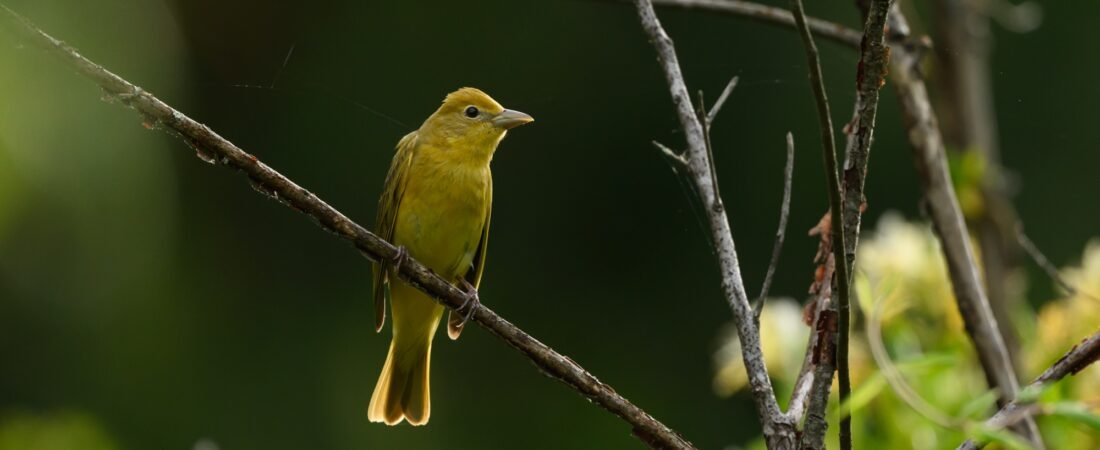
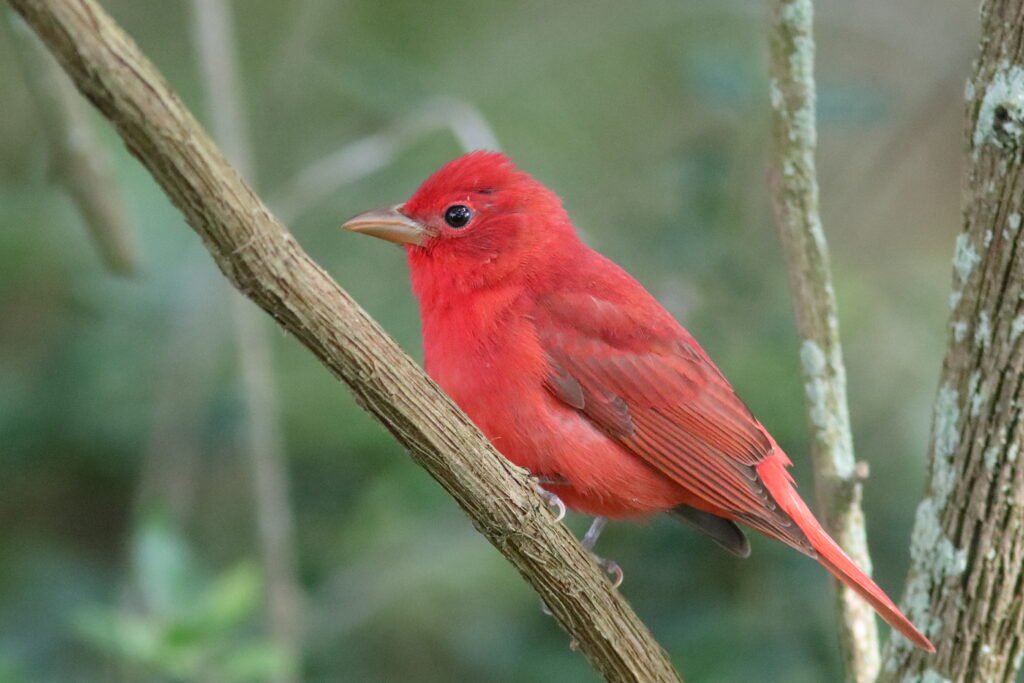
The only completely red bird in North America, the strawberry-colored male Summer Tanager is an eye-catching sight against the green leaves of the forest canopy. Females, pictured at top, are bright yellow-green—yellower on the head and underparts and slightly greener on the back and wings. Molting immature males can be patchy yellow and red.
Summer Tanagers tend to stay fairly high in the forest canopy, where they sit still and then fly out to catch insects in midair, or move along tree branches to look for food. Fairly common during the summer, these birds migrate as far as the middle of South America each winter. Like most birds that migrate long distances, the Summer Tanager puts on large fat deposits to fuel its long flight. In one study, tanagers arriving in Panama had enough fat to fly an estimated additional 890 km (553 mi).
The Summer Tanager is a bee and wasp specialist. It catches these insects in flight and kills them by beating them against a branch. Before eating a bee, the tanager rubs it on the branch to remove the stinger. Summer Tanagers eat larvae, too: first they get rid of the adults, and then they tear open the nest to get the grubs. And while they mostly eat bees and wasps, they also eat other aerial and terrestrial invertebrates—such as spiders, cicadas, beetles, ants, termites, grasshoppers, flies, moths, and bugs—as well as fruits such as mulberries, blackberries, pokeweed, Cecropia, citrus, and bananas.
Summer Tanagers breed in gaps and edges of open deciduous or pine-oak forests across the southern and mid-Atlantic U.S. During migration, Summer Tanagers stop in habitats similar to those of their breeding range, as well as parks and gardens. The nest is usually within a cluster of leaves or a fork of branches overhanging a road, creekbed, or treefall gap in the forest.
The female gathers the nest material and builds the nest by herself, though the male may accompany her as she moves back and forth. Using dried grasses and other herbaceous vegetation, she weaves a crude cup measuring about 3.5 inches across and 2 inches high on the outside, with an inner cavity about 1 inch deep and 3 inches across. Each clutch has 3-4 eggs and they have 1-2 broods per season. The female incubates the eggs by herself while the male forages, preens, and rests. In some breeding pairs, but not all, the male brings food to his incubating mate. However, all males seem to bring food on the day the chicks hatch, and the parents share feeding duty for the nestlings. When the young leave the nest at about 10 days old they are barely able to fly, so they take cover in vegetation and beg for food by calling periodically. Their parents feed them for at least three weeks after they fledge.
If you’d like to spot a Summer Tanager, listen for their distinctive robin-like song, and their “pit-ti-tuck” call note. Click here to listen to both species singing and calling.
If you’d like to learn more about Summer Tanagers, click here.
Source: Cornell Lab All About Birds
Feature Photo: Female Summer Tanager – Gina Sanders