
Of all the songbirds, Purple Martins stand out as relying almost exclusively on humans. Not for food, but for housing. And not just a nest box here and there, but whole condominiums of nest boxes! Native Americans started many years ago by providing empty gourds for martins to use for their nests. As this trend continued, putting up martin houses became so common that by the early 1800s nearly every inn or tavern had a Purple Martin box attached to their sign. In fact, in 1831, John James Audubon used them as a rating system of sorts, to help decide which tavern to choose for his overnight lodging. He remarked, “Almost every country tavern has a martin box on the upper part of its sign-board; and I have observed that the handsomer the box, the better does the inn generally prove to be.” Today that habit of providing housing has aided the martins as farmland disappears, and logging and the practice of removing dead trees from yards and landscapes reduces available natural habitat.
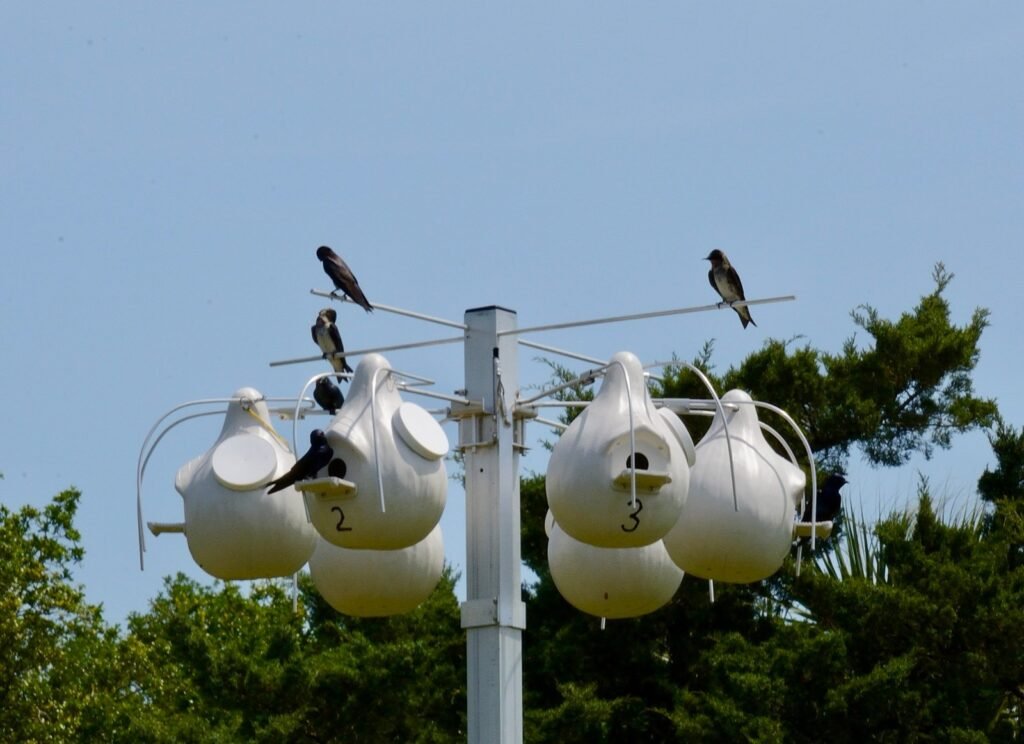
Purple Martins in the western half of North America still use natural cavities, but here in the east Purple Martins have come to depend almost exclusively on gourds and elaborate houses in which to build their nests and raise their young each summer, establishing whole colonies in parks and backyards. Last year, Seabrook Island, with support from the town and Seabrook Island Club, became Purple Martin landlords. Our first collection of nesting gourds was installed at the equestrian center and we welcomed a successful brood of Purple Martin chicks. In early spring, Purple Martins start returning to their breeding grounds and usually to the same location as in previous years. We’re hoping for a full colony of martin families again this year.
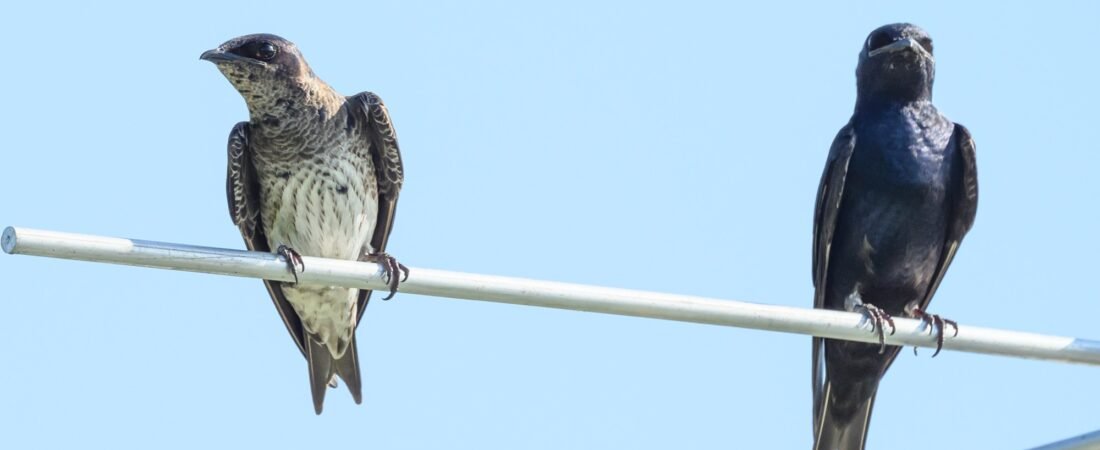
Now before you go outside and look for purple birds flying around, you should know what you’re looking for. First, they’re not a true purple. Adult males are iridescent, dark blue-purple overall with brown-black wings and tail. Females and immatures are duller, with variable amounts of gray on the head and chest and a whitish lower belly. They’re a member of the swallow family, actually the largest swallow in North America. They’re smaller than a robin, but larger than a tree swallow. They fly rapidly, in big circles in the sky, with a mix of flapping and gliding.
They eat insects – a lot of insects. And they catch all their food in flight. When they encounter prey, they flip sideways or upward, speed up, and then flare their tails as they trap the insect. Their menu includes beetles, flies, dragonflies, damselflies, leafhoppers, grasshoppers, crickets, butterflies, moths, wasps, bees, caddisflies, spiders, cicadas, termites, and mayflies. They also eat mosquitoes, but not enough to make a dent in our mosquito population as they make up only 3% of their diet. Purple Martins not only get all their food in flight, they get all their water that way too. They skim the surface of a pond and scoop up the water with their lower bill.
Both males and females visit several cavities before choosing a site. In fact, a female chooses her mate largely based on the nest site he occupies. In other words, she picks her favorite house and takes the mate that comes with it. Each clutch is between 3-6 eggs, they have 1-2 broods per year, and once hatched, chicks leave the nest in 27-36 days.
As we gear up for our second season as Purple Martin landlords, be sure to glance over at the equestrian center and watch for Purple Martin activity. And if you’re out that way, make sure you listen for their melodious song. If you’re interested in joining our Purple Martin team, please email us at seabrookislandbirders@gmail.com.
To learn more about Purple Martins, click here.
To learn more about becoming a Purple Martin landlord, or about their conservation in general, please visit the Purple Martin Conservation Association.
Photos by Jen Jerome and Gina Sanders