
Anyone who has been following my series on our vacation in Ecuador knows that I covered the Galapagos Island in a series of 4 blogs, and Ecuador via 4 blogs focusing on specific groups of birds – Antpittas, Hummingbirds, Toucans and Allies, and Tanagers. All this barely scratched the surface. In this final blog about Ecuador, I want to focus on some of the oddball birds that were special to find. For all but two of these species we needed to go to very specific locations where the birds had been found and carefully documented so we could find them. For each species, I intend to point out why they are so unique and some interesting details about these birds. We would travel long distances and spend lots of time just to find these special birds. When we would make a special trip, the species count for the location usually was very low.
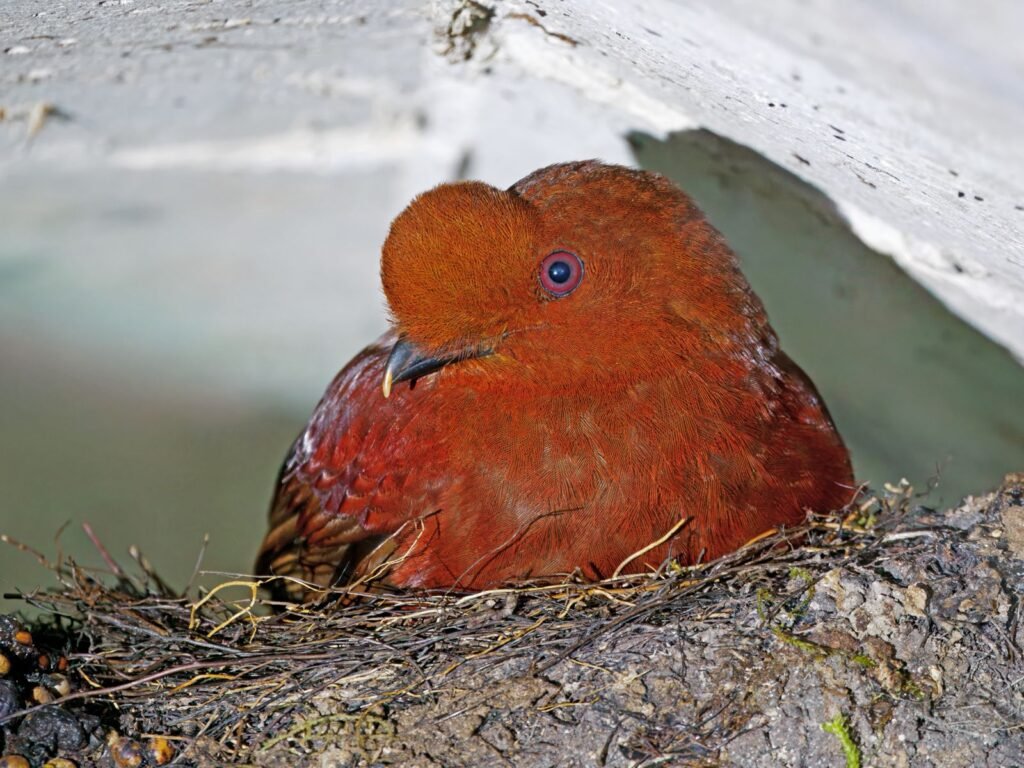
On August 4, 2025, we made a trip just to see the Andean Cock-of-the-Rock. Andean Cock-of-the-Rocks use a system of leks for breeding. A group of males gathering in one location and displaying for the occasional female that stops by defines a lek. In this case, the males start displaying before sunrise, screaming like a stuck pig. This audio comes from the great site on bird sounds, Xeno-cantos.org. https://xeno-canto.org/936838 I tried to capture an image and a recording of the sound, but it was still dark and there were too many people marveling at the cacophony. We arrived at 5:45 am and walked down a slippery trail to an overlook where we could “see” and hear the lekking males. While making these wild noises, the males jump around and display their bodies. We could tell when a female approached the lek as the noise grew by many decibels.
Leaving the lek, we traveled to a bridge over a creek where one of the Paz brothers had located a nesting female. This picture is of her sitting on the nest under the bridge. Once again, it was very dark and my image did not come out. Our guide Edison Buenano, the owner of Sword billed Expeditions and a professional photographer, took this image.
The Andean Cock-of-the-Rock stand about 12 inches tall. Decked out in bright red with that odd bump in its head they are quite shy and hard to find away from the lek. We would find a lone male on the east side of the Andes. They can also be found on promotional images and souvenirs as they are so unique. I now own a Cock-of-the-Rock pair of socks.
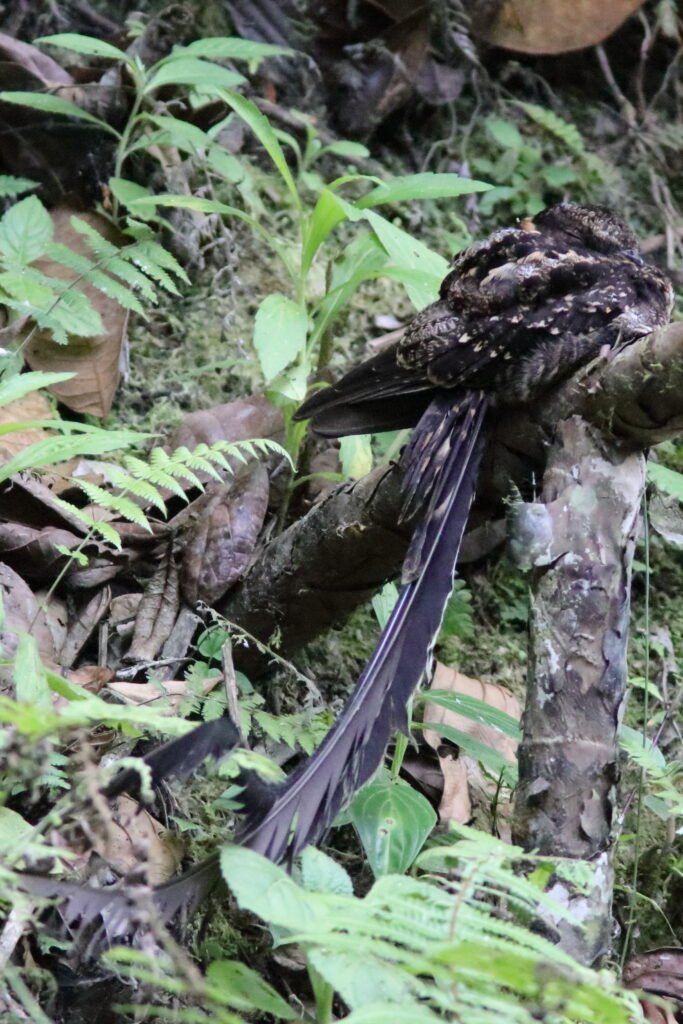
Under that same bridge where we saw the female, we also found a nesting Lyre-tailed Nightjar. Two days later, on August 6, 2025, we made a big side trip stopping right across from where we listened to the Cock-of-the-Rock and walked up a steep path where a male Lyre-tailed Nighthawk quietly waited for the sun to set. This 10-inch bird has a tail extending an additional 25 inches.
Like other nightjars (nighthawks, Whip-poor-wills, and Chuck-will’s-widow are all nightjars), they feed from sunset to sunrise, being most active near dawn and dusk. Nightjars, also known as goatsuckers, have huge mouths. Old wife’s tales claimed the goatsuckers would suck the milk from female goats making the goats go dry. Not true. They use that huge mouth to scoop up insects while on the wing.
Cryptically colored, these birds are hard to find. This individual likes this spot and has probably been photographed more than any other Lyre-tailed Nightjar. We never saw them flying and can only imagine how that long tail works and looks in flight.
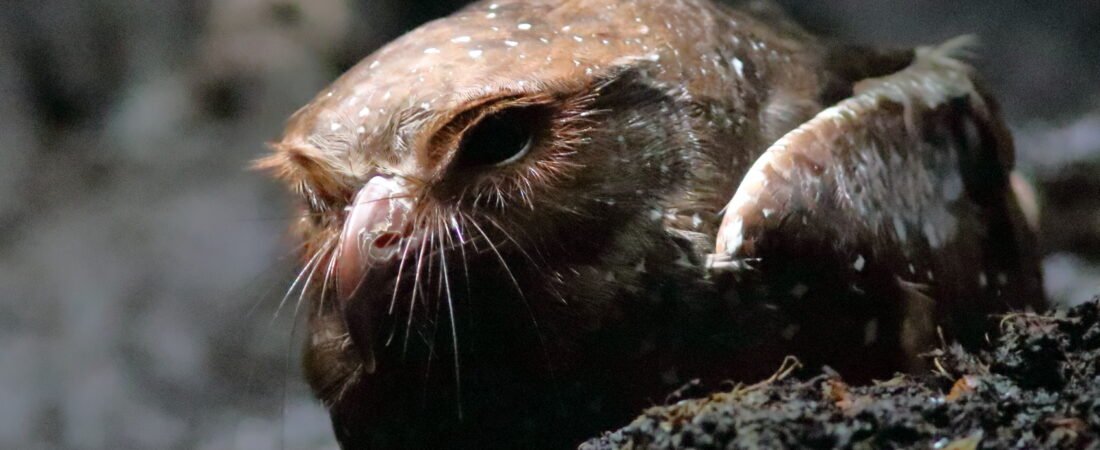
On August 5, 2025, we once again made a side trip to see just one species, the Oilbird. This species breaks many bird rules. It is another nocturnal bird but feeds only on fruit. They have the most sensitive eyes of any known vertebrate and an excellent sense of smell. They also use echolocation like a bat does to move around in the deep caves where they roost and nest. Only one other genus of birds, the swiftlets, use echolocation. We traveled to a known location where we would find about 10 of these birds tucked up into the cracks along the walls of the crevasse on a cliff side.
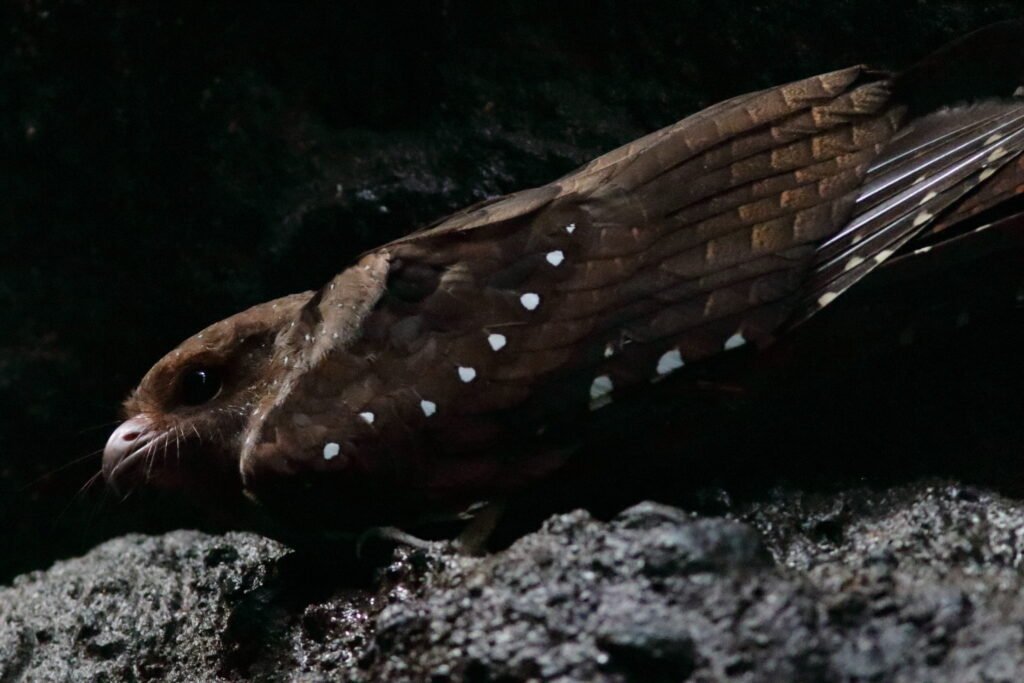
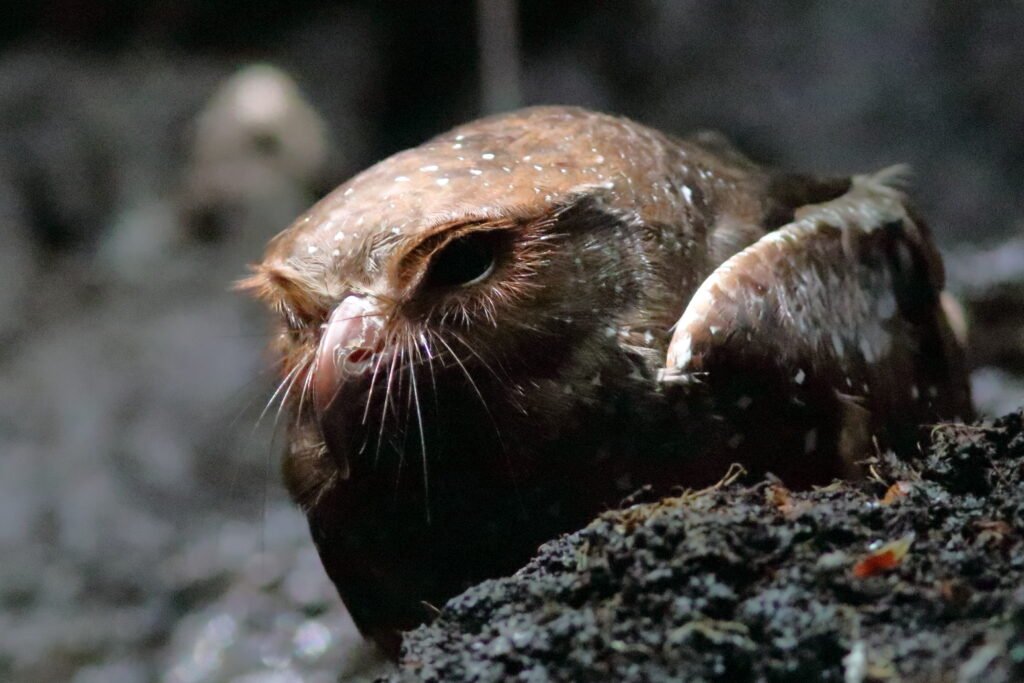
Our guide, Edison explained that the oilbirds were relentlessly hunted for the oils in their body. I needed to do some research and found an article in Audubon Magazine written by Carson Vaughan entitled “The Oilbird: Is This Thing Even a Bird?” In this article, he relates how the first European to collect an Oilbird specimen was the great naturalist Alexander Von Humbolt in 1799. The cave he visited in Venezuela contained thousands of Oilbirds. The natives knew all about these birds. They knew that Oilbirds fed their young an oil rich diet as one of their preferred foods was oil palm. The plump young were so saturated with oil, the natives would come into the mouth of the caves with long pole, smash the nests and collected the fallen young.
The people rendered the fat and used it for flavoring, oils for torches, and any possible way a person might use oil in the 1700’s. Fortunately for the Oilbirds, the natives believed the spirits of their ancestors resided in the same caves. Therefore, to respect the dead, they would only collect the birds near the mouth of the caves. Despite the Oilbird being considered a species of least concern, to find an oilbird, one must visit a known roost. At this location, we only recorded 4 species. Oilbirds were the stars!
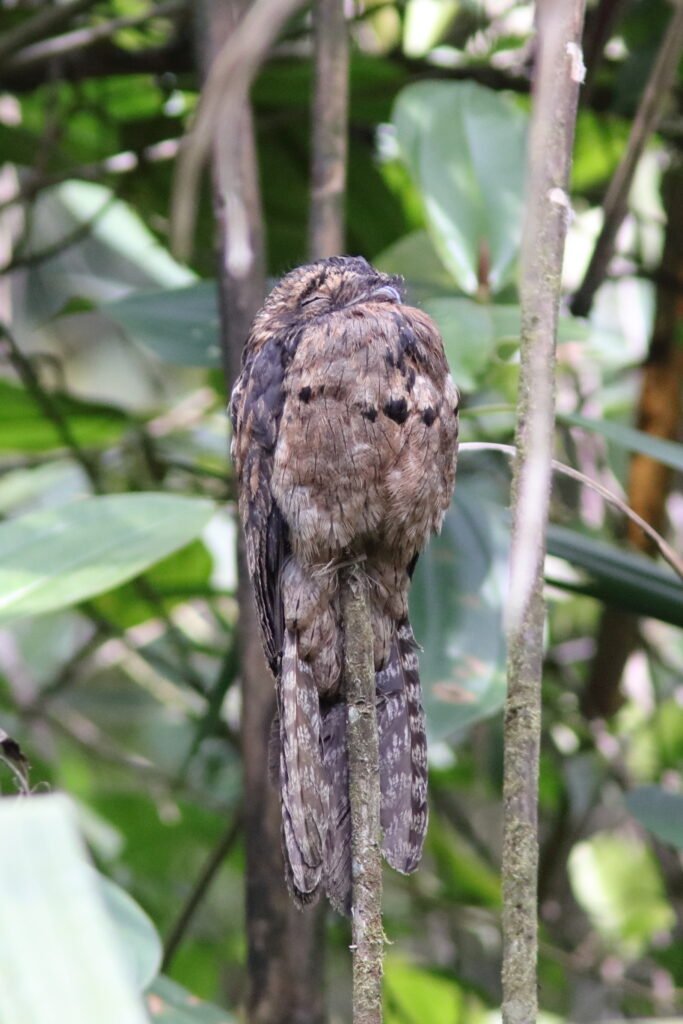
The next day, August 6, 2025, we stopped at the Punto Ornitologico Mindo where one of their staff had found a Common Potoo. Potoos, another nocturnal insect feeder, spend the day sitting still. They usually sit up in a tree on a broken vertical snag. This makes them look like a part of the snag, an excellent form of camouflage. They even lay a single egg on a snag with no other adornments. We marveled how this particular bird chose this skinny little stick as its perch, obviously not large enough to hold an egg. Furthermore, this tiny stick also does not make the best camouflage. While not uncommon, the common Potoo are devilishly difficult to find. The locals know this and search diligently and spread the word to the guides if they have one staked out. When they find one and spread the word, the finders are rewarded with income from us tourists. Here, we only identified 7 species.
The next two birds are not a nocturnal bird. We found the Russet-backed Oropendola and Crested Oropendola at bird feeders munching on bananas.
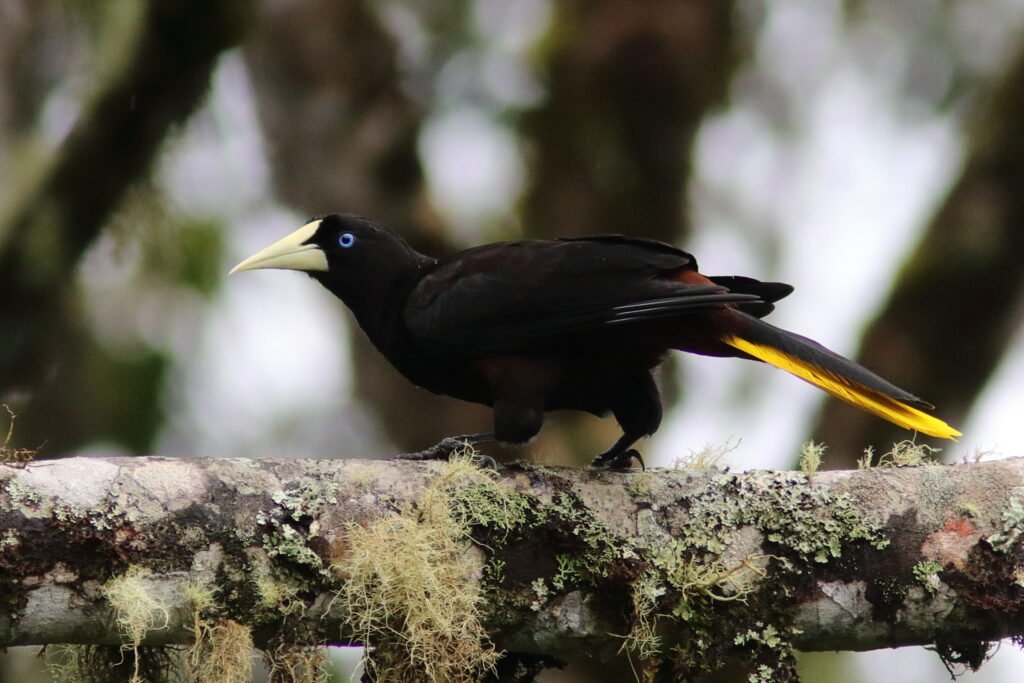
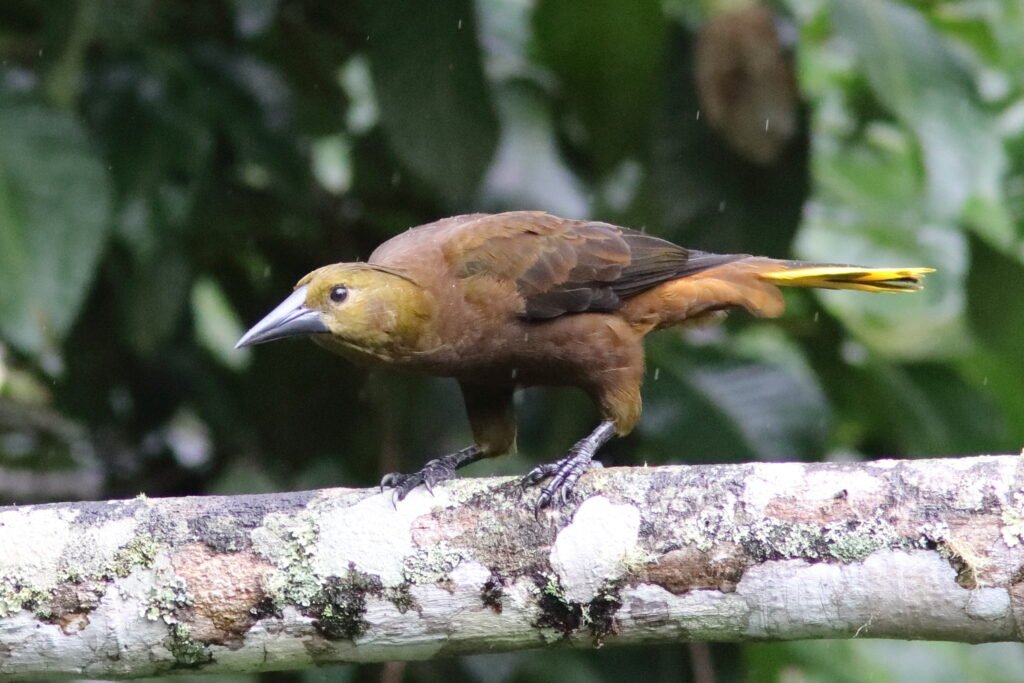
Related to blackbirds and orioles, Oropendolas are huge, the size of a crow. Their fibrous nests dangles from tree limbs like an oriole’s nest only HUGE, up to five feet long. Furthermore, they nest in large colonies with reports of up to 100 birds. Imagine seeing a tall tree with dozens of three- to five-foot-long oriole nests and birds loudly clicking, screaming, and whistling. Below, I included some audio from Xeno-cantos for each species. Eileen and I did not see any nests at this time, but while in Costa Rica and Panama on previous trips we did.
The Russet-backed Oropendola and the Crested Oropendola look very different. They both have those massive bills and, like most oropendolas, yellow feathers in the tail. The name oropendola translates from Spanish as – oro-gold and pendola-feather referring to the yellow tail feathers on most oropendola.
The Crested Oropendola https://xeno-canto.org/479545
The Russet-backed Oropendola https://xeno-canto.org/890780
I chose the next three birds not because they are beautiful, but because they required us to travel to high elevations between 10,000 and 12,000 feet above sea level. For two of them, I had never even heard of these genera.
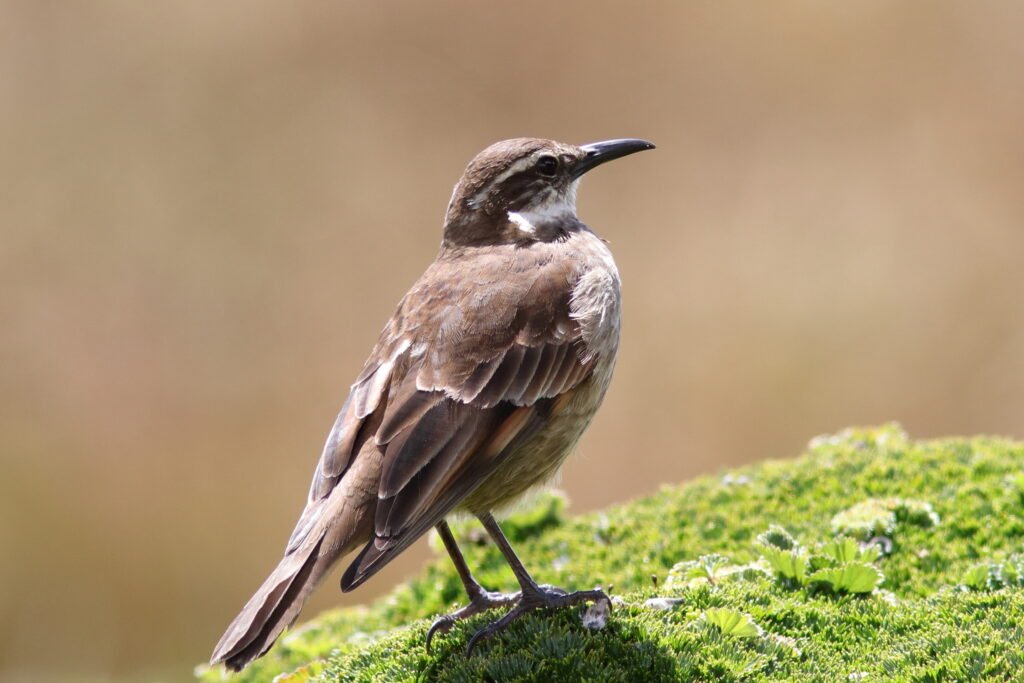
First, the Stout-billed Cinclodes. It took me some practice to be able to pronounce the name correctly “sin clods” (Soft C for the S sound, hard C, hard O, silent E). As we drove through the Reserva Ecologica Antisana, we watched carefully for a robin sized bird that feeds on the ground blending in with the dried grasses. These birds can only be found in the high elevations of the Andes Mountains, necessitating a long drive up into the mountains. While it is not a stunning bird, it is unique.
In the same habitat, we also looked for the Many-striped Canastero. Smaller than the Cinclodes, and well camouflaged, we were delighted to find this well named bird. It says something when the Birds of the World Website says this about the Many-striped Canastero. “Despite its relative abundance, virtually nothing is known concerning the species’ life history and behavior.” What is known is they can usually be found in the Andes Mountains in elevations between 9,000 and 13,500 feet above sea level.
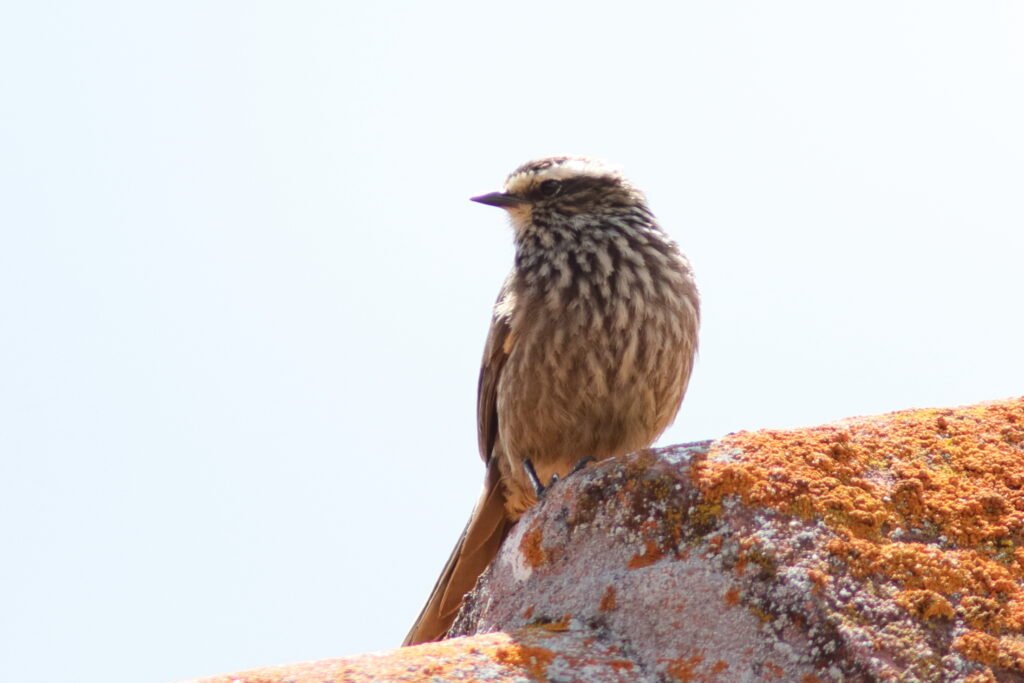
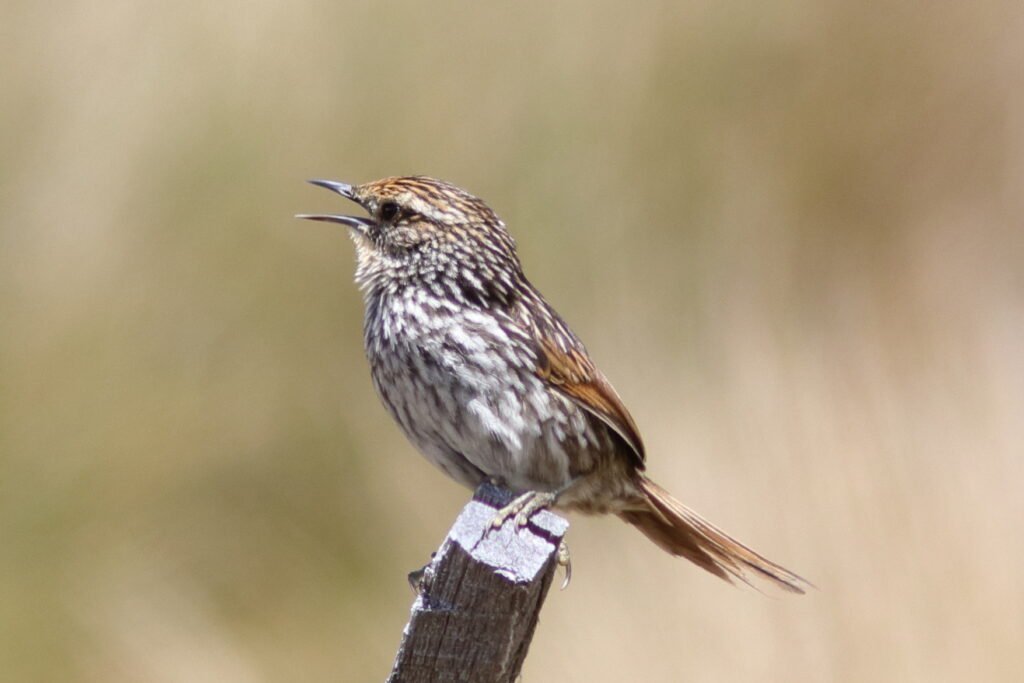
Both of these birds live in the Páramo ecosystem. This habitat resides where trees don’t grow due to the cold and harsh conditions and snow does not cover the ground year-round. The ecosystem can be compared to tundra. Also, the high altitude means available oxygen is reduced. The soil or the Páramo can be rocky, wet, and marshy. The living conditions are harsh. In Ecuador, some of the Páramo escaped development when Ecuador set aside about 460 square miles of land as the Reserva Ecologica Antisana. Looking at the expanse in this picture, one can image the challenge of finding the above two birds.
Note the puff of smoke over the active volcano.


The Silvery Grebe also lives in the high altitudes of the Andes of Ecuador. We were fortunate enough to watch two pairs have a territorial dispute very close to the shore we were standing on. One feature of the Páramo is glacial lakes. The Silver Grebe in Ecuador uses those lakes. It looks very similar to some of the grebes in North America, especially the winter plumage of the Eared Grebe or Horned Grebe. to which they are closely related. The big difference is that the Silver Grebe does not change into a different plumage with the season.

The last two birds were found together, and they were the only birds we found at this location. Their names give away the challenge of finding them—the Torrent Duck and the Torrent Flycatcher. Both of these birds can be found on rapidly running rivers. The male Torrent Duck is a stunner. The Torrent Flycatcher is a tiny non-descript bird. Note the color of both perfect for hiding in the rapids. As we drove through Ecuador, we stopped at many bridges in hopes of finding these birds. The Torrent Duck swims up and down the river rapids plucking insects from the rocks both above and below the water. The Torrent Flycatcher sits on the rocks in the river, then sallies out to grab a bite of insects on the fly.
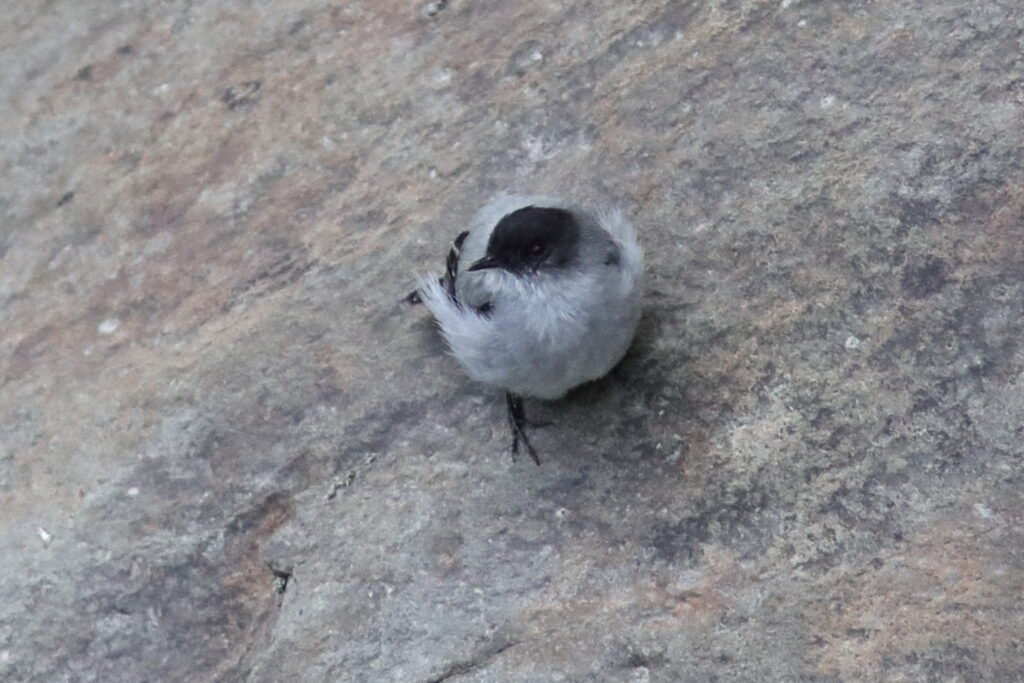
While we were able to find 400 species of birds on our trip to Ecuador, I will end with this collection. If you ever think about going to Ecuador, I tell you not to miss it. Go with a group so someone can take you to the best locations and identify the birds so you don’t spend all your time rooting through the unwieldy field guide (any field guide trying to cover 1,700 species will be unwieldy). It is a wonderful country. We always felt safe (except on some of the roads). The people we met were incredibly friendly. It was an experience to remember.
References
https://birdsoftheworld.org/bow/species/steato1/cur/introduction
https://www.audubon.org/magazine/oilbird
Written by Bob Mercer
Photos by Bob Mercer, unless indicated