
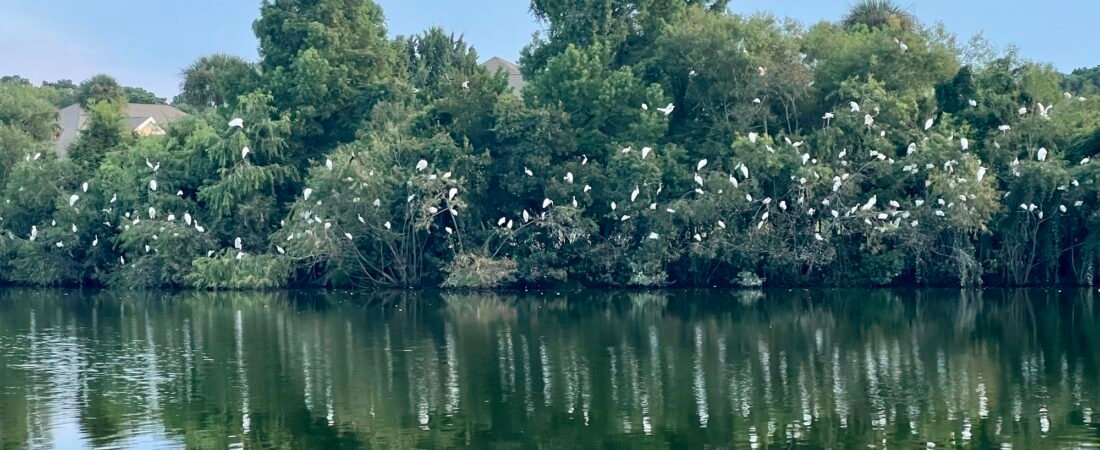
“Some of the residents are curious about those beautiful white birds that flock to the trees around the lakes. What are they? Why do they roost there? Is it a seasonal thing, etc?”
They noticed that recently, large numbers of the egrets (Great and Snowy Egrets) and White Ibis pour into the trees and shrubs around the Lake House and a few other key locations throughout Seabrook Island. They may also have noticed the Wood Storks hanging around the pond in front of the Lake House.
These birds are all large, white waders (birds that wade in marshes to feed). The Wood Stork is the largest and can be recognized by its black head. Next in size is the Great Egret, a pure white bird with a yellow bill and black legs. The Snowy Egret looks very similar to the Great Egret but is smaller with a black bill and bright yellow feet. The White Ibis adults and immature birds look totally different with the adults white and the immatures being brown. The distinguishing characteristic of an ibis is the long pink bill that curves downward. This brief description should enable people to recognize the four major species and answer the question, “What are they?”
For a successful life, all species need food, water, and some sort of shelter. The different species of birds have different feeding and “shelter” strategies. As a rule, all of the birds only use a nest to raise their young. After that, they face the elements elsewhere. The young birds often disperse away from their home territories to form new locations and to reduce inbreeding. All of the Wood Storks on Seabrook Island are immature birds. Throughout their lives, birds face many dangers. The waders have developed a way of living to make sure they are safe.
To address both the food and safety issues, most species of waders evolved to create communal roosts. A communal roost allows birds of the same or even multiple species to settle down together for the night. During the day, the birds spread out to feeding areas, occasionally returning to the roost to rest. Often, many birds can be found feeding in close proximity. One hypothesis for this states that spending the night together allows the birds to communicate good feeding locations to the birds nearby. Not enough is known about the behavior of individual birds, but it is possible that birds trail a leader to a good feeding location based upon the tide and other factors. It is known that Great Egrets find decoys attractive; most likely they think the decoy indicates a feeding heron. This may work the same way a restaurant with many cars out front advertises a good place to eat. At night, the dangers for waders stem from predators like raccoons, foxes, coyotes, owls, and even feral cats.
During the non-breeding season, waders gather together in trees and dense shrubs near water, resting during the day and spending the night in the communal roosts. As the sun sets, the birds pour into the roost. That does not mean all is peaceful. Watch the birds coming into a communal roost, and one will notice a lot of bickering as each bird negotiates for the best space. This can look rather violent but they generally work it out without damage.
Another hypothesis for communal roosts revolves around safety. A predator can approach the roost by water or by climbing around in the trees and bushes. Choosing a roost near the water, over the water, or, better yet, on an island, adds additional protection. A predator that chooses a water approach generally creates ripples and splashes that can alert the birds of the approaching predators and exposes the predator to alligators during the season when alligators are active. If the predator approaches by land, it needs to enter the dense shrubs. With multiple eyes and ears alert for any approaching predators, the probability that at least one bird will see or hear an approaching predator and notify all of the others of the danger is very high!
Scientific study has confirmed neither hypothesis. It is remarkable how little is known of these very common birds!
During the fall and winter season, the Seabrook Island Birders often schedule activities where participants watch the masses of birds joining the roost in the evenings. During the spring season, the egrets go one step further. They choose a location where they can build a rookery, a place where many birds build nests to raise their young in relative safety. Each year, the Seabrook Island Birders plan a visit to a rookery. Consider joining one of these explorations.
Written by Bob Mercer
Photo by Gina Sanders