

If you thought the hummingbirds were numerous (134 species), the family Cardinalidae has 178 species in Ecuador, this includes but is not limited to Cardinals, Tanagers, Flowerpiercers, Honeycreepers, Danis, Seedeaters, Finches and Saltators.
Since there are so many bird species in Cardinalidae, I will focus this blog just on the birds with Tanager in their name. In my previous blogs, I primarily talked about the birds and spent little time talking about the experience. This blog will track our travels and the birds seen each day. There will be lots of tanager names and images of those I was able to photograph. Since we would discover some birds multiple times, their names will appear multiple times. Those in bold accompany the image. Those with an asterisk* indicate an image of this bird will be shown later. Those with two asterisks** indicate this species was covered earlier. All others are birds we identified, but I was unable to photograph.
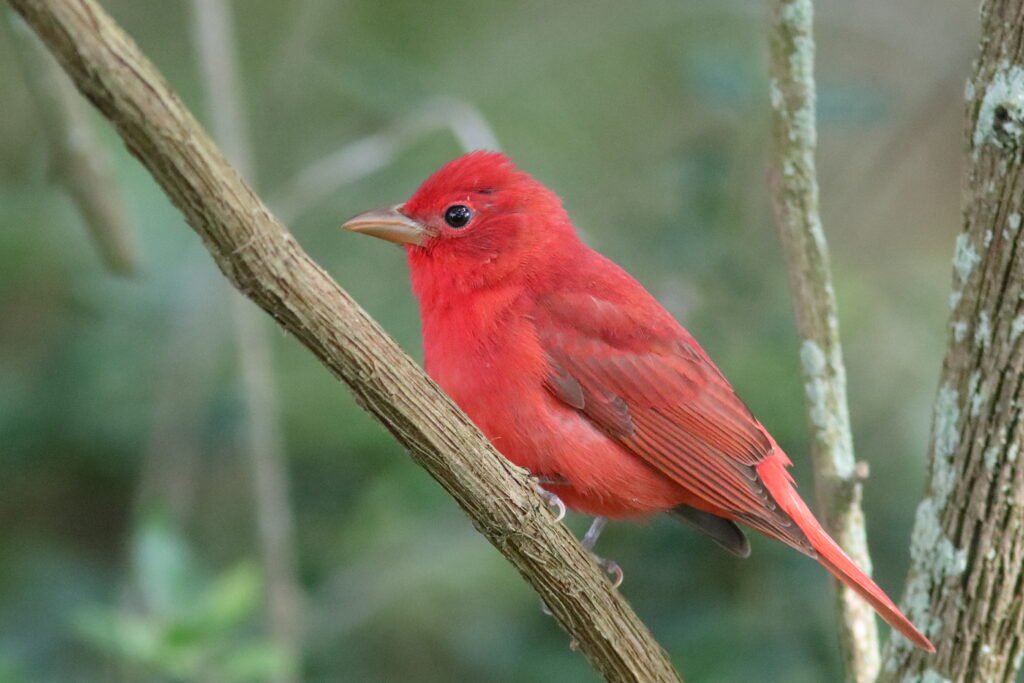
In the eastern United States, tanagers amounts to two species with one additional irregular visitor. The Scarlet Tanager (image at the start) is a summer bird in Pennsylvania where I live. The Summer Tanager is a common breeding bird in South Carolina where I spend my winters. Both of these birds will show up in Ecuador in our winter. The Western Tanager occasionally occurs in both states during the fall and winter when a bird migrates in the wrong direction.
In Ecuador the birds with tanagers in their name are numerous-78 species!!! We would find 36 of them. I was able to snap pictures of only 15 species.
Anyone who is familiar with our species of tanager will be amazed at the stunning varieties in the tropics.
The tanagers often travel in mixed species flocks. I missed getting photographs of many of them because once a flock was found, the birds would rapidly work their way down the tree line. Our leader, Edison Buenano, bird guide and owner of Swordbill Expeditions, leads trips all over South America. His knowledge of the birds in each country constantly amazed us. We highly recommend him! When a flock of tanagers was blasting through, Edison would be naming them so fast and the birds were moving so fast, I couldn’t get the camera focused fast enough. I gave up and looked at them through my binoculars. To give you an idea, I will go day by day and pinpoint the Tanager species we found each day and share the pictures I did secure. I hope to show the abundance or limitations of the various species and share some images. As a result of listing birds each day, you will find some species names repeated over and over. Fortunately, at some of the locations the tanagers were attracted to the feeding stations facilitating photography.
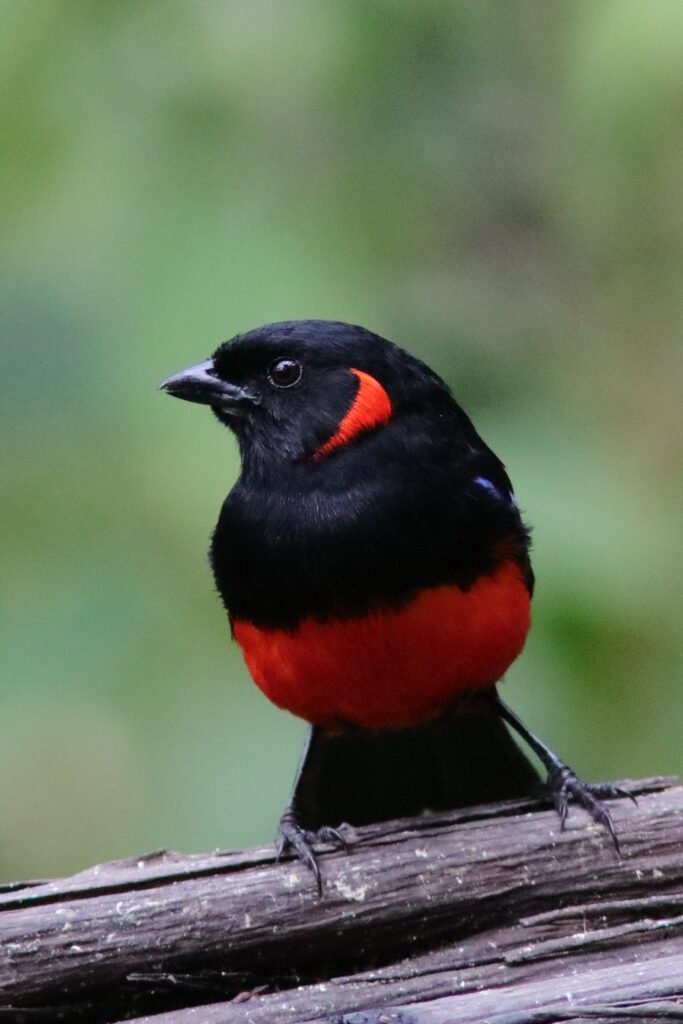
Our first birding location in Ecuador where we found a tanager species was Zuro Loma on July 20, 2025, the day before we went to the Galapagos Islands. We woke up at 4:00 AM and, with a box breakfast in hand, we boarded a full-sized bus. Our travels started out on highways through Quito then on to secondary roads which slowly deteriorated the further from Quito we went. The last 4 miles of the trip were up a road I might take with a four-wheeled drive vehicle. We crawled slowly up the mountain side, us passengers cringing and clinging to our seats with white knuckles as the driver negotiated the hairpin turns at a snail’s pace. We would arrive at 7:15AM. It took about an hour and a half to go the 45 miles.
Here was a place for hummingbirds and antpittas. A single species of tanager, a Scarlet-bellied Mountain-Tanager, came in to a feeder and gave us a show.
There are no tanagers in the Galapagos Islands, so we would not see another species of tanager until we returned to the Hostería San José de Puembo in Quito where a Blue-and-Yellow Tanager stopped by the gardens on July 31, 2025. We stayed at this location for 3 days prior to the Galapagos Islands, 2 days between the Galapagos Islands and the Ecuador West to East trip, once again as we traversed from west to east, and again 2 days prior to our flight to Peru. It was a very nice hotel with delicious food.
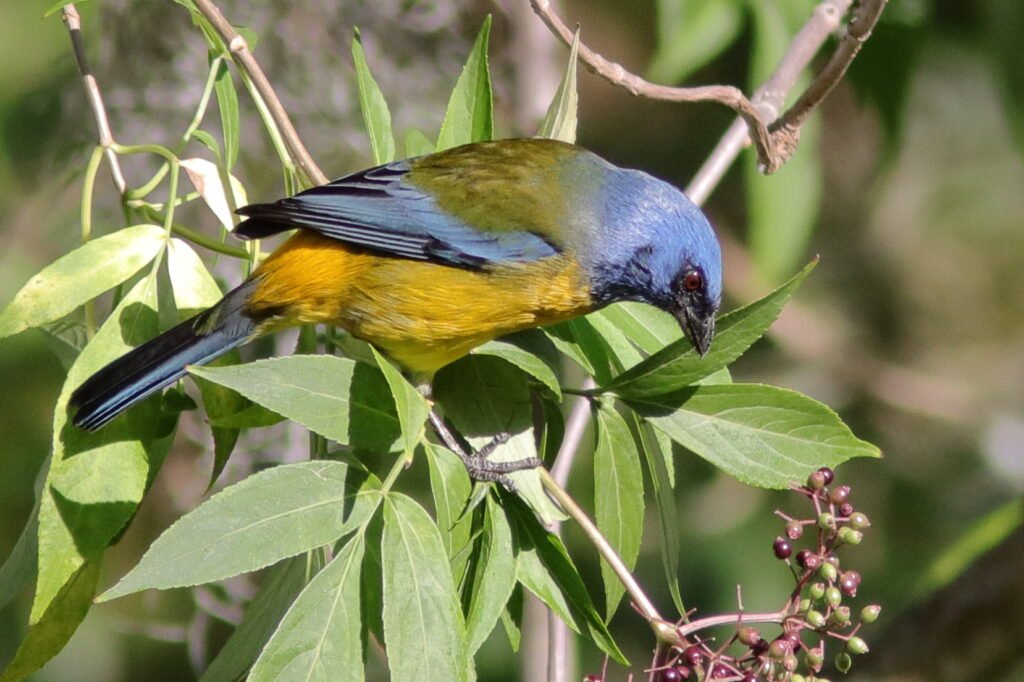
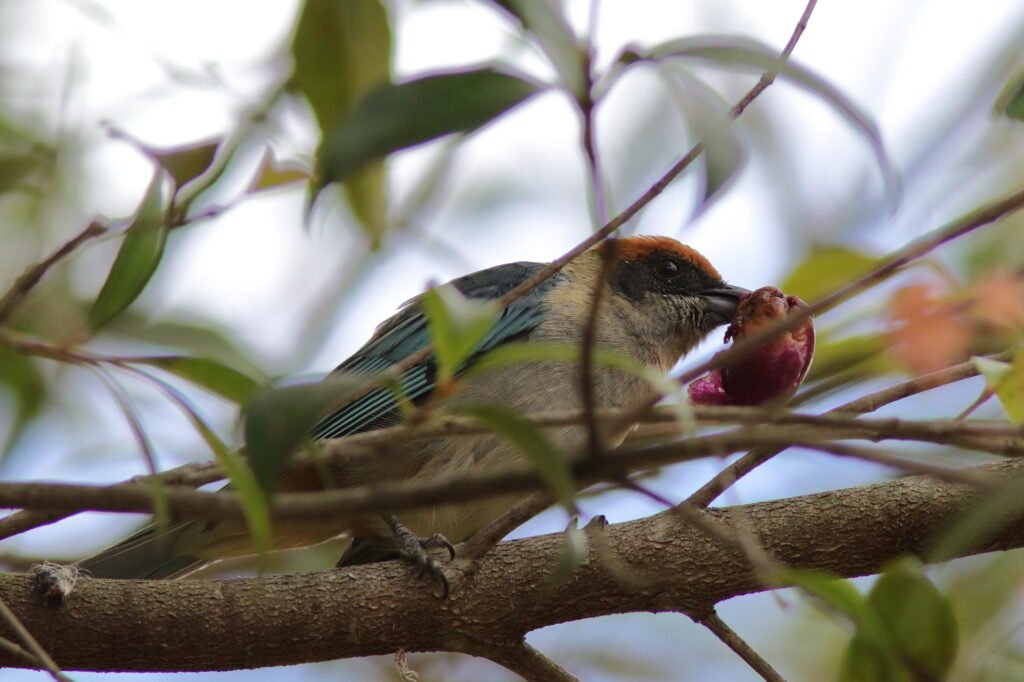
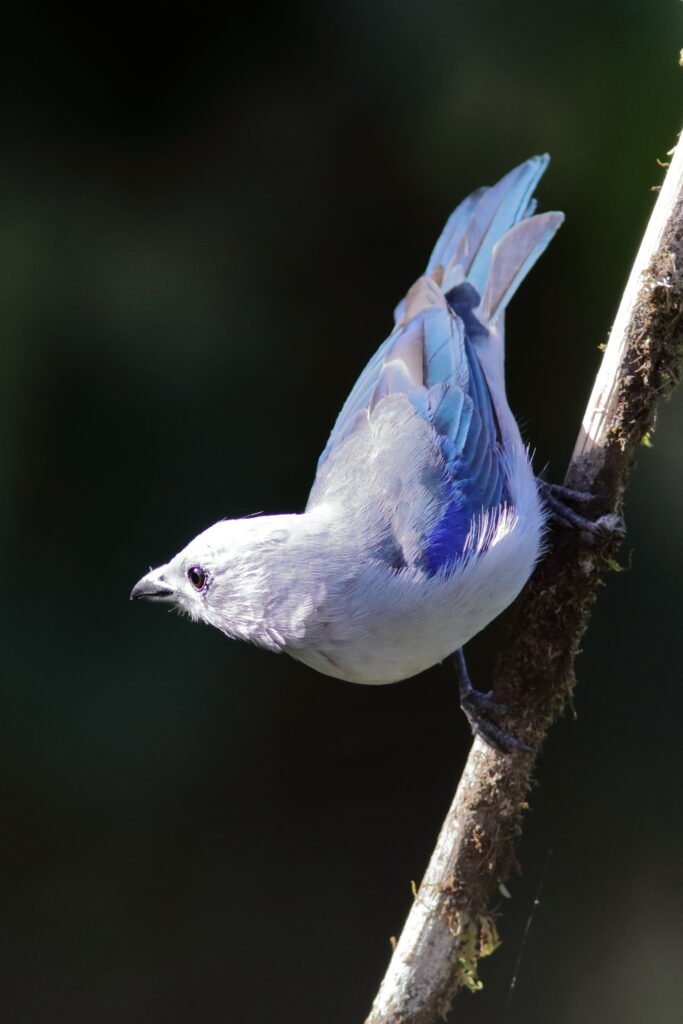
On August 2, 2025, at the Hostería San José de Puembo, we found the Blue-gray Tanager* and the Scrub Tanager. We would find the common Blue-gray Tanager on nine occasions, so more on them later. On the other hand, this was the only time we found the Scrub Tanager. This bird species likes disturbed areas and is not usually found as high as the hotel is. This may be a sign of some range expansion encouraged by human disturbance.
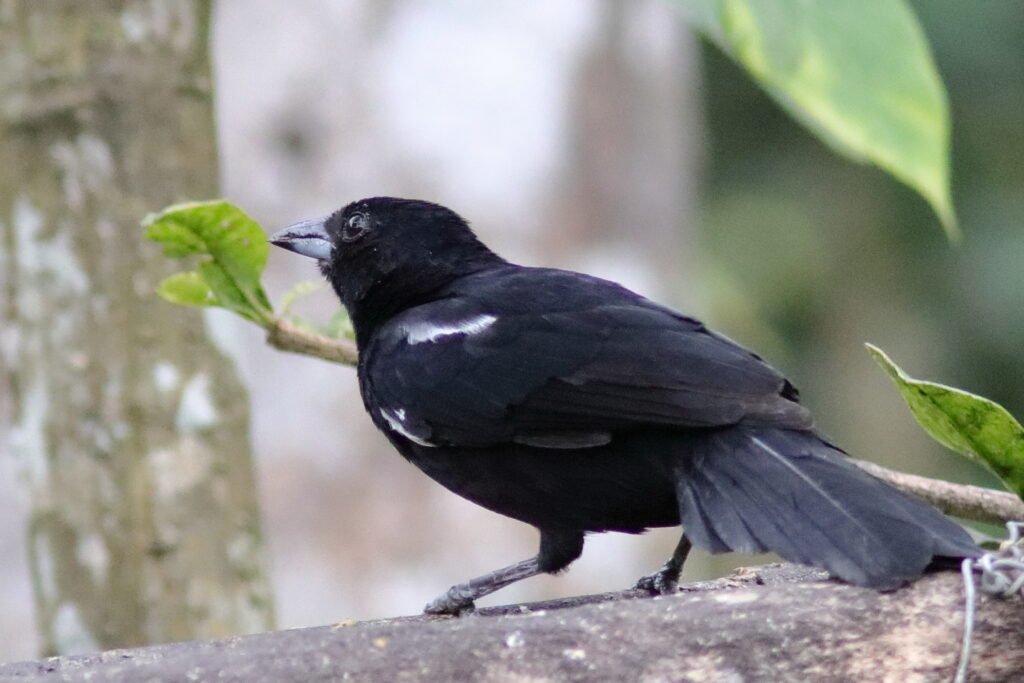
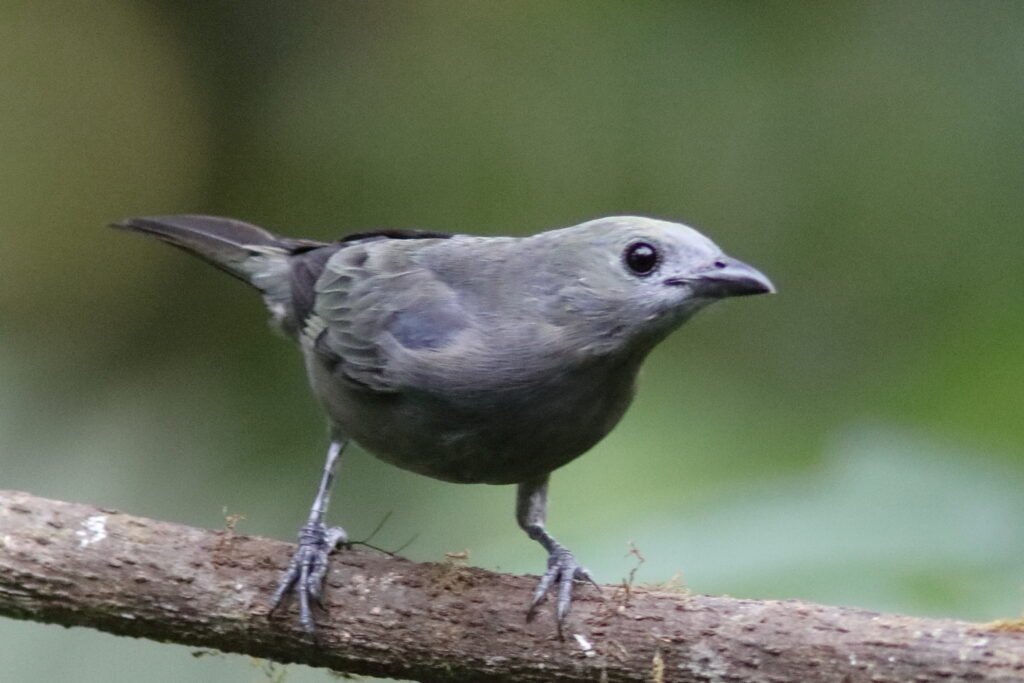
Day 1 The formal birding part of the Ecuador West to East trip started on August 3, 2025, our “first day”. We would travel once again to Zuro Loma. Now, the five of us participants, our guide Edison, and our driver Wilson were in a 15-passenger van. The drive was challenging, but not so terrifying as when we came here in a full-sized bus. Here we saw the Scarlet-bellied Mountain Tanger** once again. We traveled to the Alambi Reserve in the afternoon. We hit a tanager jackpot of six species at the Alambi Reserve. They included the White-lined Tanager*, Flame-rumped Tanager*, Blue-gray Tanager*, Palm Tanager*, Golden-naped Tanager*, and Golden Tanager*. I was able to get images of four of these birds, so there is a little more on each of those below.
The White-lined Tanager’s common name is like our Red-bellied Woodpecker’s name. It highlights a feature that one normally does not see. The male, an almost solid black bird, does have a tiny splash of white on its wing and the underwings show some white. The female in her brown coat has no white at all.
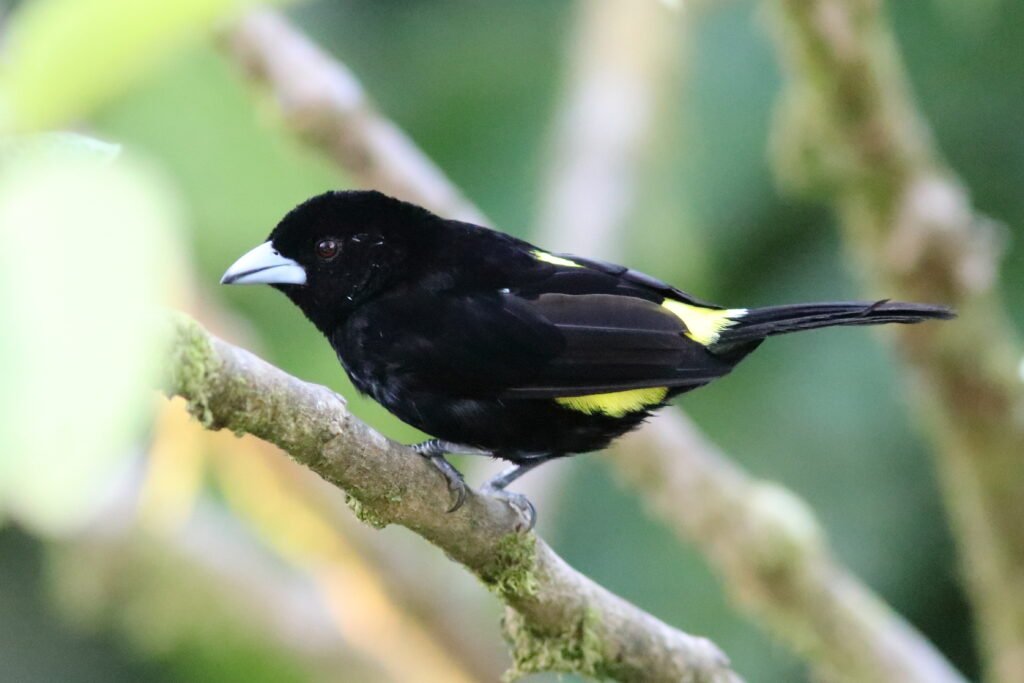
The Flame-rumped Tanager is another bird we would find at four different locations. Looking at the pictures, one wonders how it received its common name. Almost every reference adds an additional name. The birds we would see in Ecuador always showed up as Flame-rumped Tanager (Lemon-rumped). In other parts of South America, one can find the Flame-rumped Tanager (Flame-rumped) a bird with a bright red rump. Despite how different these birds look, taxonomists decided to lump these two into the one species since there is a zone of hybrids indicating that they can interbreed.
We found the Palm Tanager in six different locations. Found throughout a large portion of Central and South America, this species is very common, though very plain.
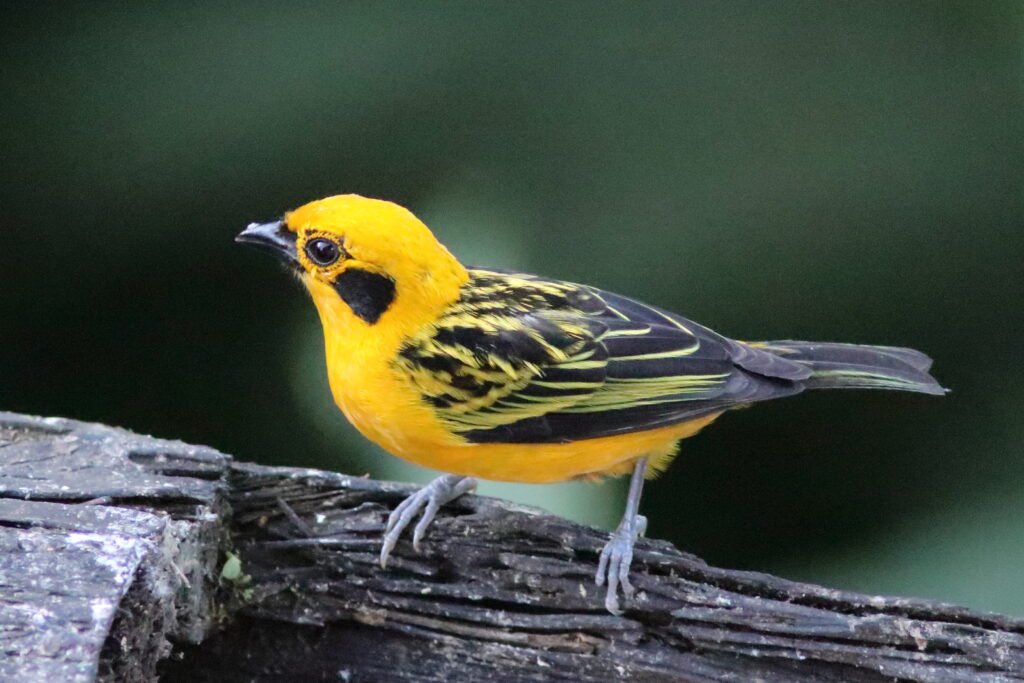
After a plain bird like the Palm Tanager, the Golden Tanager jumps out! This well named bird lives on both sides of the Andes Mountains in Ecuador, but they live within a tight elevation range of between 3,000 and 4,500 feet above sea level. We would find them in five locations with some on either side of the Andes.
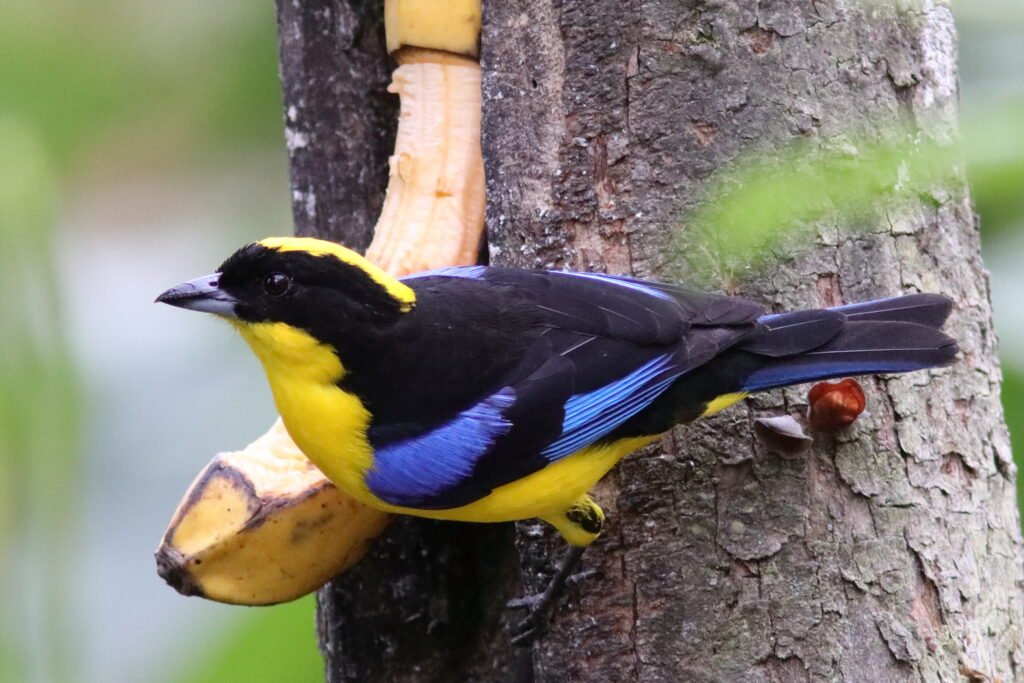
Day 2 We ate an early breakfast at the El Septimo Paraiso Lodge and drove to Refugio Paz de las Aves (Ángel Paz) just 18 miles away. It would take us a half hour as the last 2 miles were a rough dirt road. Our ebird list shows a start time of 5:54 AM. We would spend seven hours here and find eight species of tanagers. They include: Blue-winged Mountain Tanager*, Blue-gray Tanager+, Palm Tanager**, Golden-naped Tanager*, Beryl-spangled Tanager*, Metallic-green Tanager, Flame-faced Tanager*, and Golden Tanager**.
The Blue-winged Mountain Tanager was one of just three tanagers I photographed at this location. It will show up at two more locations. The range map for this species shows them on both sides of the Andes Mountains. Since they range from an elevation of 3,600 to 7,500 feet, the two populations never meet.
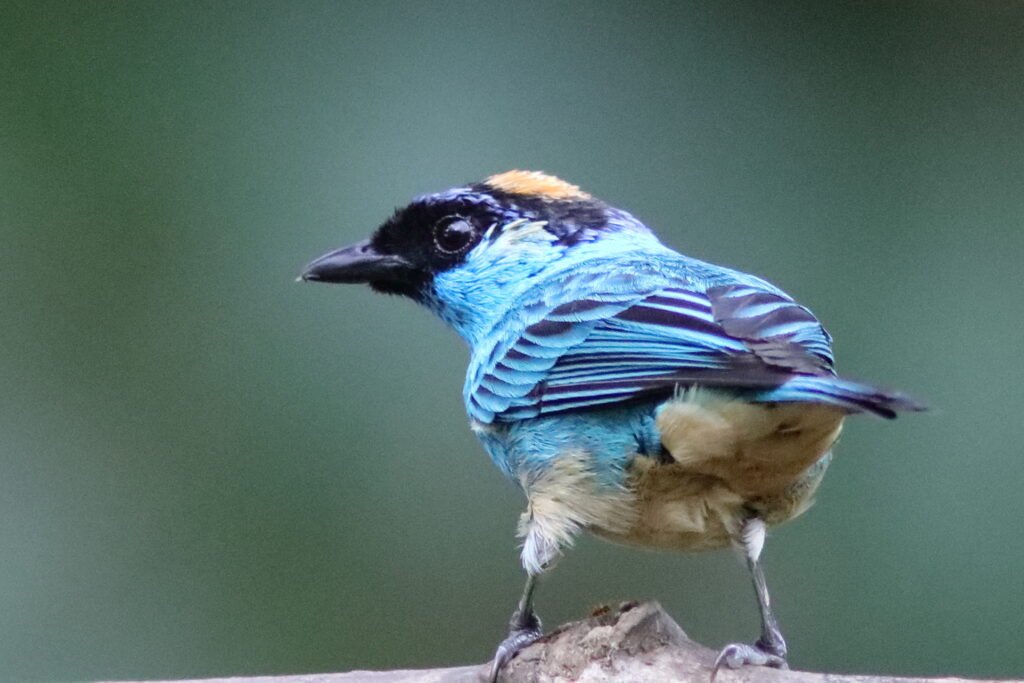
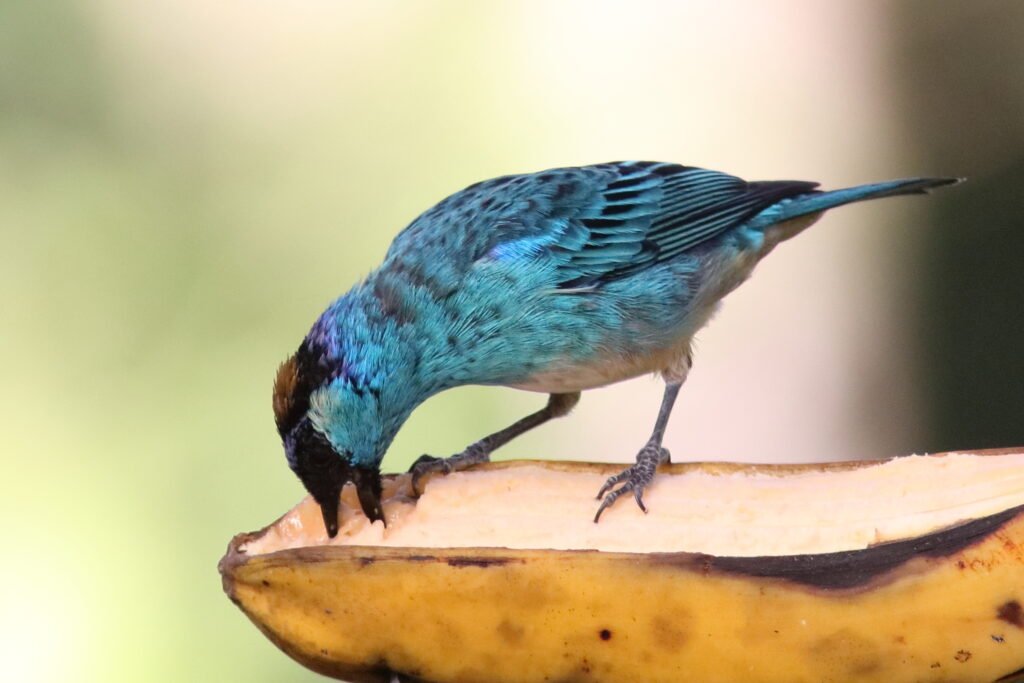
The second tanager I photographed was the Palm Tanager, already shown. The third was the Golden-naped Tanager. While we saw it earlier and saw it two more times after this, this was the first time I captured an image. Like the previous bird, it resides on both sides of the Andes Mountains (3,300 to 7,200 feet) where the populations never meet.
Later in the day, we traveled to the Milpe Bird Sanctuary where we found only the Silver-throated Tanager. This night we stayed again at the El Septimo Paraiso Lodge, ironically an Ebird birding hotspot we never found time to explore.
Day 3 We started out at the Reserva Mashpi-Amagusa, located 35 miles from our lodging, it took about an hour and a half drive. (Just in case you haven’t figured it out yet, the roads we had to travel varied from highways to dirt tracks. Many were very rough.) We started birding at 6:20 AM so we could enjoy the early birds. We spent 6 hours here. The tanagers did not disappoint us! We had eleven species: Ochre-breasted Tanager, Flame-rumped Tanager**, Moss-backed Tanager*, Black-chinned Mountain Tanager, Glistening Green Tanager*, Blue-gray Tanager*, Rufous-throated Tanager*, Golden-naped Tanager**, Flame-face Tanager*, Golden Tanager**, and Swallow Tanager. What an array of names and one can anticipate the range of colors!
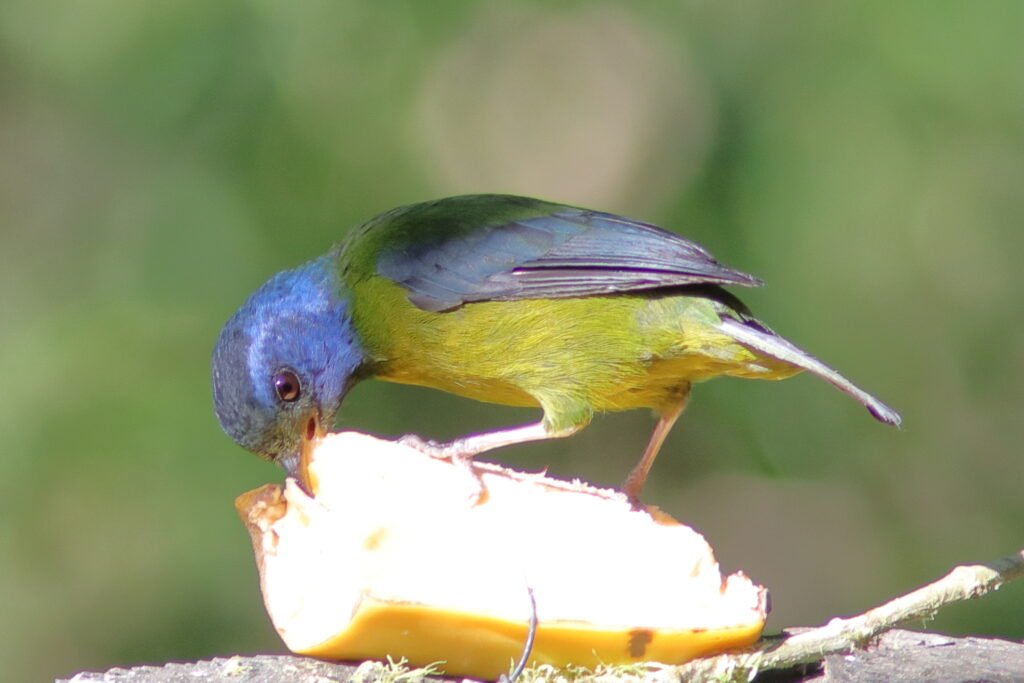
The Moss-backed Tanager, a very subtly colored bird,has a mossy green body with blue on the head and wings. With a range restricted to the west side of the Andes mountain in only Colombia and just into Ecuador, this would be the only time we see this species.
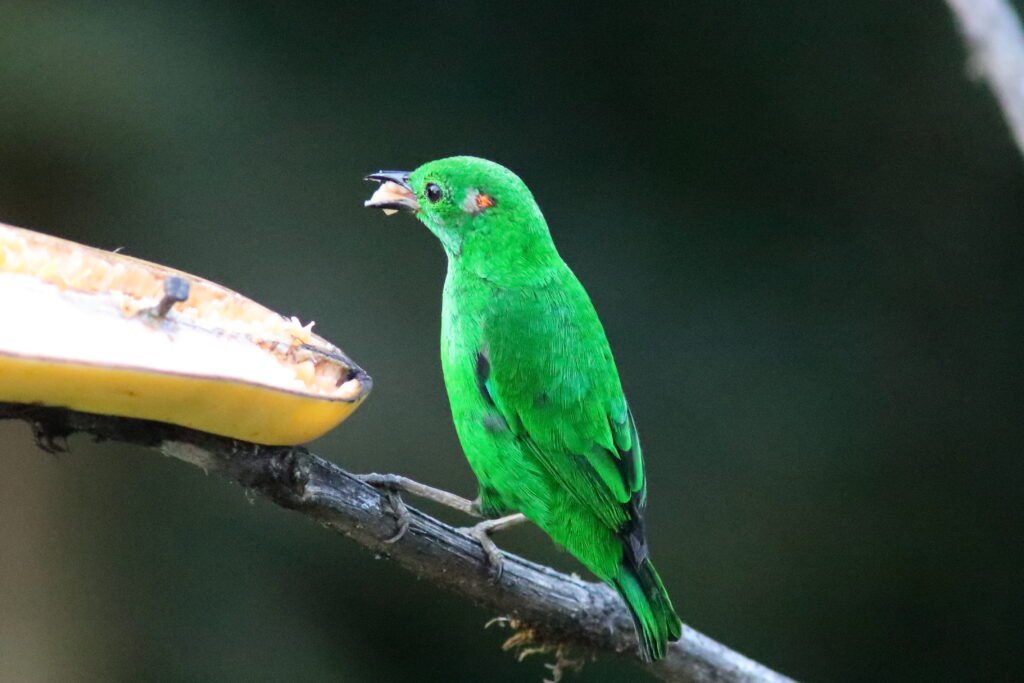
The Glistening-green Tanager, lives up to its name! Like the previous bird, it can only be found on the west side of the mountains and only in Colombia and Ecuador, though it extends farther north and south than the Moss-backed Tanager. Other than the green body, the red ear spot provides the only other color on this striking bird.
We found the Blue-gray Tanager in many locations, but this was the first one to pose for me. There are two major groupings, the Blue-gray Tanager (Blue Gray) and the Blue-gray Tanager (White-edged). We would eventually see both. A very common bird with a large range extending from Mexico to Brazil and Bolivia it can be found on both sides of the Andes Mountains in Colombia and Ecuador.
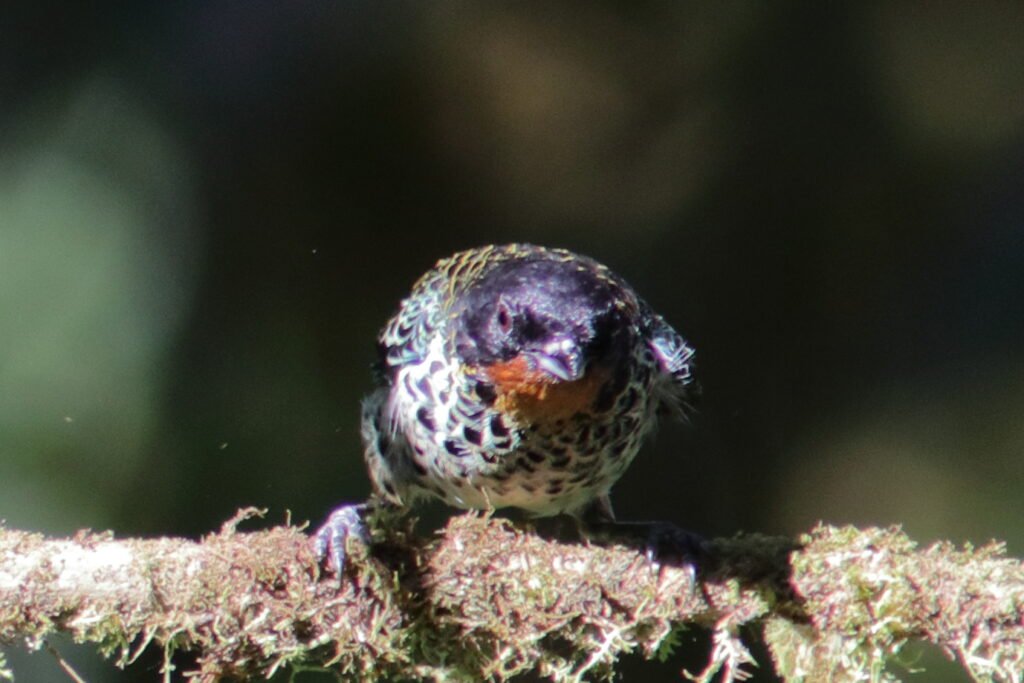
The Rufous-throated Tanager can be recognized by its scaly pattern and the rufous throat patch. The male and female of this species look alike. A small tanager, it can often be found in the mixed species flocks. It is restricted to just the northwest corner of Ecuador into Colombia, usually between 1,200 to 6,300 feet above sea level. Unfortunately, this was the best picture I could get for this species.
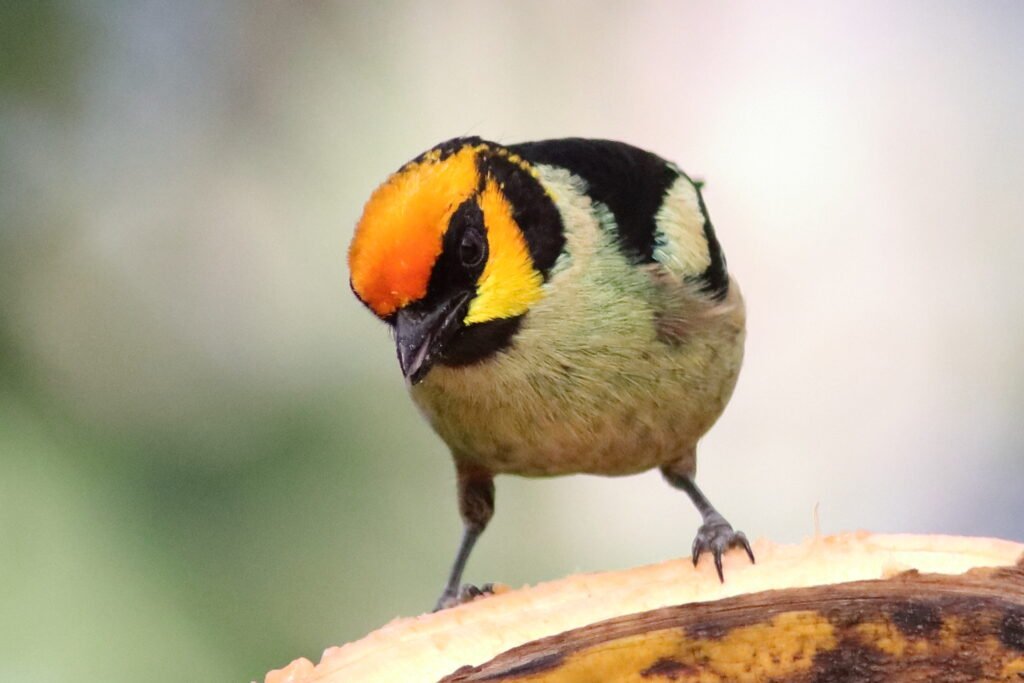
We saw the Flame-rumped Tanager** here, but also found the Flame-faced Tanager, a bird better named than the Flame-rumped. Just look at those colors! This location provided the best views as we found three individuals. These birds like hanging out with other tanagers. One study found that a flock of tanagers with the Flame-faced Tanager as one of the species had an average of eight species. Imagine our challenge sorting through these flighty birds to pick out all the species.
Later in the day, we would make a few short stops for some special species, but no tanagers.
Day 4 The start of birding required another 35-mile, hour long drive to reach the Rio Silanche Bird Sanctuary by dawn (6:30AM). Upon arrival, we climbed up a huge tower to get us up to the treetops. Here we could see birds normally found high up in the trees without getting warbler neck. I took pictures of many birds, but only one of the nine tanager species we found. We saw many of the tanagers we had seen earlier (Blue-gray Tanager, Flame-rumped Tanager, and Palm Tanager), but also some new ones: Tawney-crested Tanager, Gray-and-gold Tanager*, Golden-hooded Tanager, Blue-necked Tanager*, Bay-headed Tanager, White-shouldered Tanager, and Scarlet-browed Tanager.
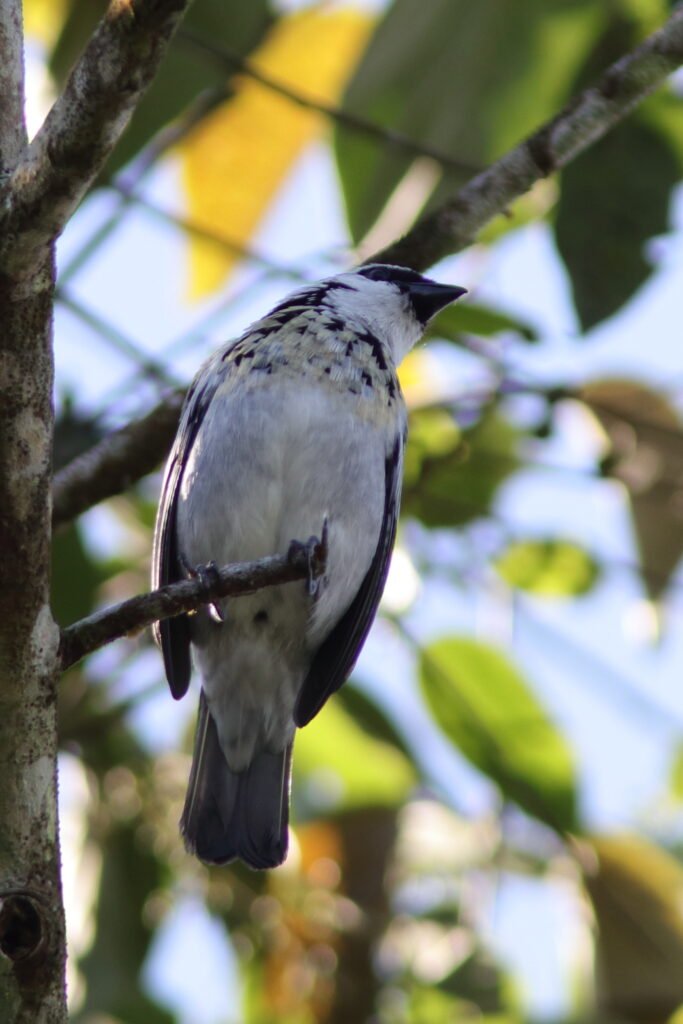
I will admit to a high level of frustration at not getting pictures of all these tanagers. The exception, the Gray-and-gold Tanager’s image hardly shows the nice pattern of color on this bird. With its range restricted to just the northwest corner in Ecuador, we would not get another chance to see this bird. I had to remind myself to enjoy the birds I saw and not stress out at missing pictures. Easier said than done.
We spent the afternoon at the Sendero Frutti Tour & Birdwatching site. We saw many birds during our two hours there of which five were tanagers, all of them ones we had seen before (White-lined**, Flame-rumped**, Blue Gray**, Palm**, and Blue-necked Tanagers). I share this picture of a White-lined Tanager, an immature male where his immature female brown plumage is changing to its black male plumage.
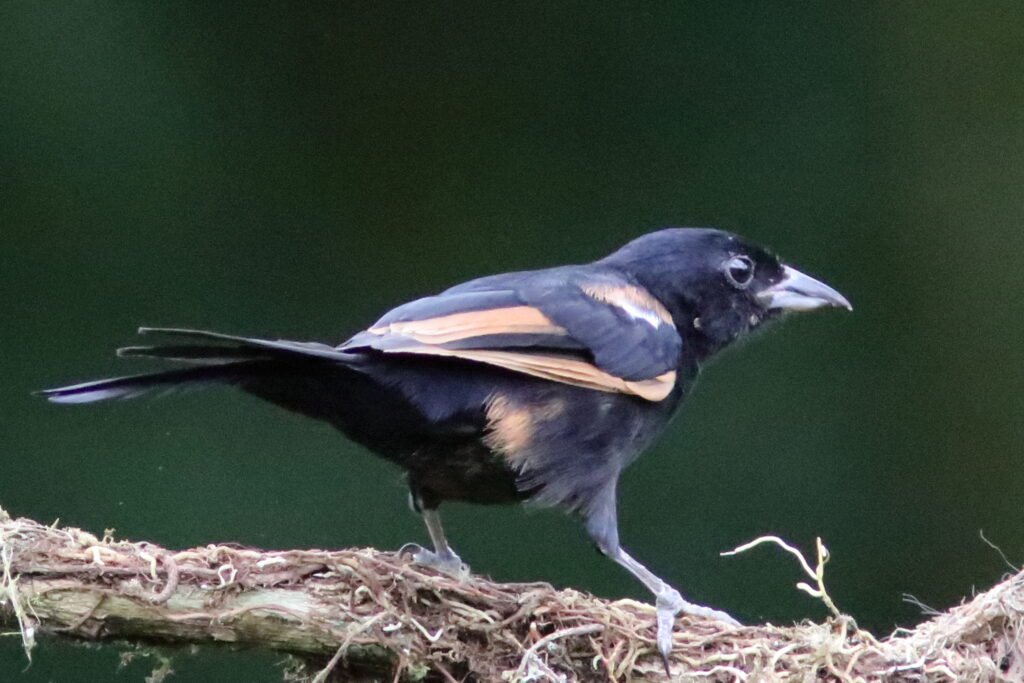
Day 5 We had more luck when we visited the Birdwatcher’s House – Santa Rosa Bird Lodge. We did not stay at the lodge, so it was another early morning so we could get to our destination (4 miles) by 5:20 AM after packing to leave the El Septimo Paraiso Lodge. During the six hours we spent at this location, I was able to photograph four of the five species we would see.
Once again, we saw the Blue-winged Mountain Tanager**, Flame-faced Tanager*, Golden Tanager**, and Golden-naped Tanager*. The Black-capped Tanager was the only new species we found. This species shows sexual dimorphism, and I was able to secure an image of both the female and male, two very different looking birds.
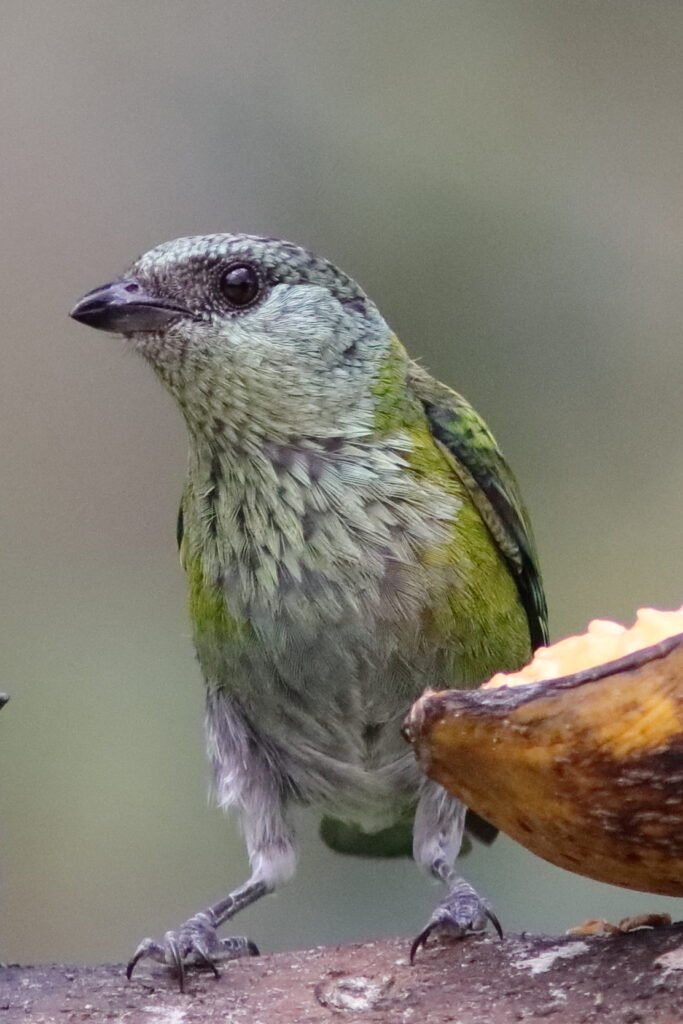
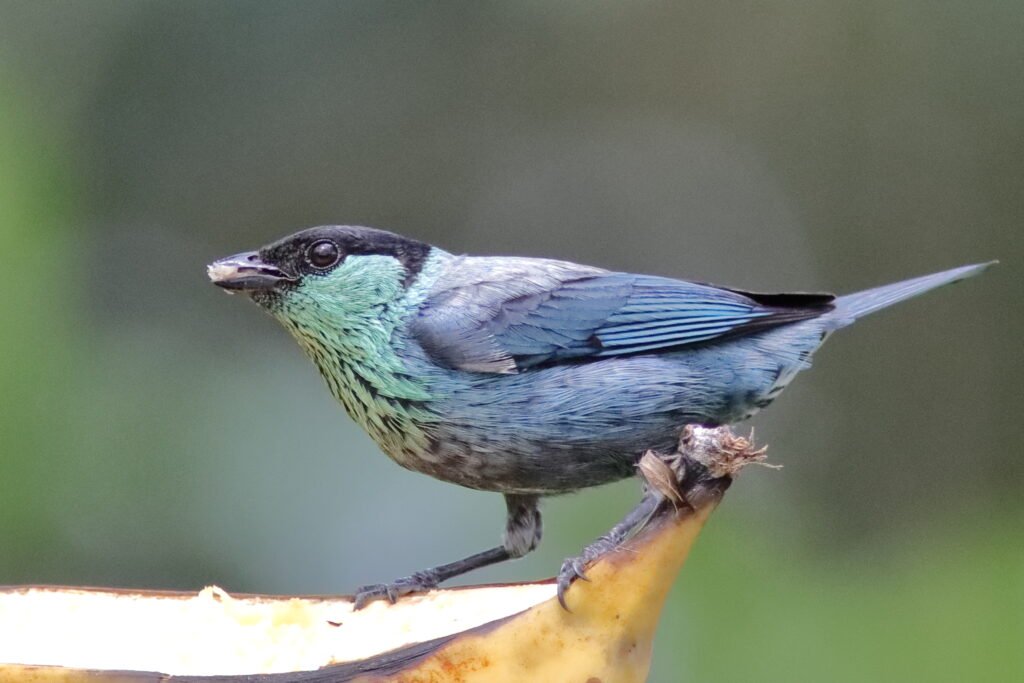
Compare that to the male and female Golden-naped Tanager where the difference is just the color of the nape of the neck.

Day 6 We explored the high altitude locations, Tambo Cóndor Bird Lodge and Antisana Ecological Reserve. There we looked for birds like Andean Condor and birds restricted to elevations between 11,000 and 13,000 feet above sea level, too high for many tanagers. The exception was a Blue-and-Yellow Tanager** in the sub-paramo (low trees and bushes as opposed to the grasslands of the paramo.)
We ended up spending the night at the Guando Lodge on the east and rainy side of the Andes. The highway to the lodge had been destroyed by a landslide earlier in the month. All the traffic between Quito and the Amazon lowlands had to traverse a secondary road. This included motorcycles, cars, small trucks, buses, and tractor trailers. Everyone was in a hurry! The rules of the road in Ecuador seemed to be mere suggestions. The one law they strictly enforce is no horns. If the traffic was slow, you passed even if it was on a curve. Twice as our van attempted to pass a tractor trailer crawling up a steep incline, our driver needed to slam on the brakes and get back behind the truck as a bus was flying around the curve ahead. The whole van either gasped or screamed as we saw that bus barreling towards us.
Day 7 We spent the morning at Guango Lodge. At 6:09 AM, we were down at a moth trap. All night long, they had lights shining on hanging white sheets. The moths settled down by the hundreds. Before dawn, a host of birds (none of which were Tanagers) would come in to eat the moths. We spent five hours exploring the grounds of the Guango Lodge. We would see Hooded Mountain Tanager*, Lacrimose Mountain Tanager*, and Buff-banded Mountain Tanager. We ran across a mixed flight of tanagers moving from tree to tree rapidly. Edison was just calling out names and pointing out where to look. The action was way too fast for me to get any pictures. I just watched birds and gave up on photography.
That afternoon we went to the La Brisa hummingbird feeders where we saw lots of hummingbirds but only saw the Blue-gray Tanager**. For the evening, we stayed at the WildSumaco Lodge.
Day 8 Before breakfast we visited the moth attracting station just before sunrise. The morning was spent at Guango Lodge watching the hummingbirds. We would also see Spotted Tanager*, Paradise Tanager, Bay-headed Tanager*, and Golden Tanager**. That afternoon, we took a walk in the rain and then after it cleared up a little, we were able to find a Blue-necked Tanager*, and a Silver-beaked Tanager. That beak is unmistakable.

Day 9 At breakfast, our guide, Edison, informed us that he was having chest pains. He had arranged for a ride back to Quito and his doctor’s. He also arranged for us to have two new guides, one for this day and one for the rest of the trip. Both were good birders, but neither had Edison’s knowledge. I needed to keep the ebird lists because neither was that familiar with the app.
That afternoon we drove to Cabanas San Isidro, just 30 miles away. Though the whole distance was “highways,” it still took over an hour. Due to heavy rains, large chunks of the highways were damaged. In five locations, the road was essentially gone and new roads were being built.
Day 10 The next morning, at San Isidro, we walked the road looking for birds and explored other areas. Then our new leader, the director of the Yanayacu Biological Station took us to the station to bird. While he knows his birds well, the birds did not cooperate. We identified 28 species, eight of which were by sound only. The only tanager was a Black-capped Tanager**.
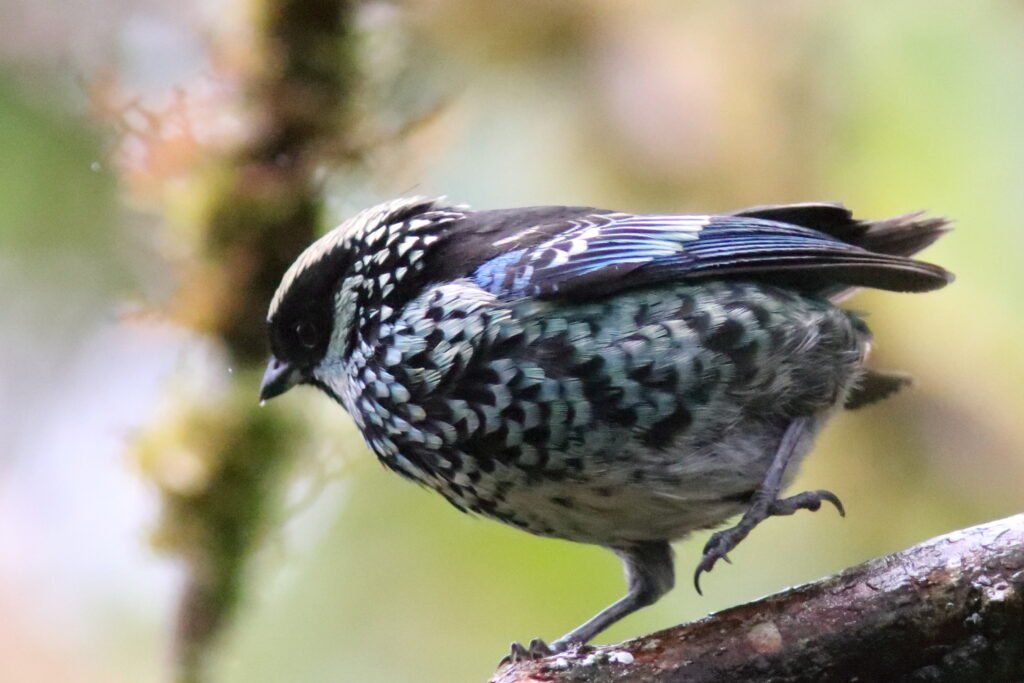
At 9:45 that morning, we were back at the Cabanas San Isidro to do more birding. We would find the Blue-winged Mountain Tanager**, the Black-capped Tanager**, and the Beryl-spangled Tanager. The picture does not do this bird justice!
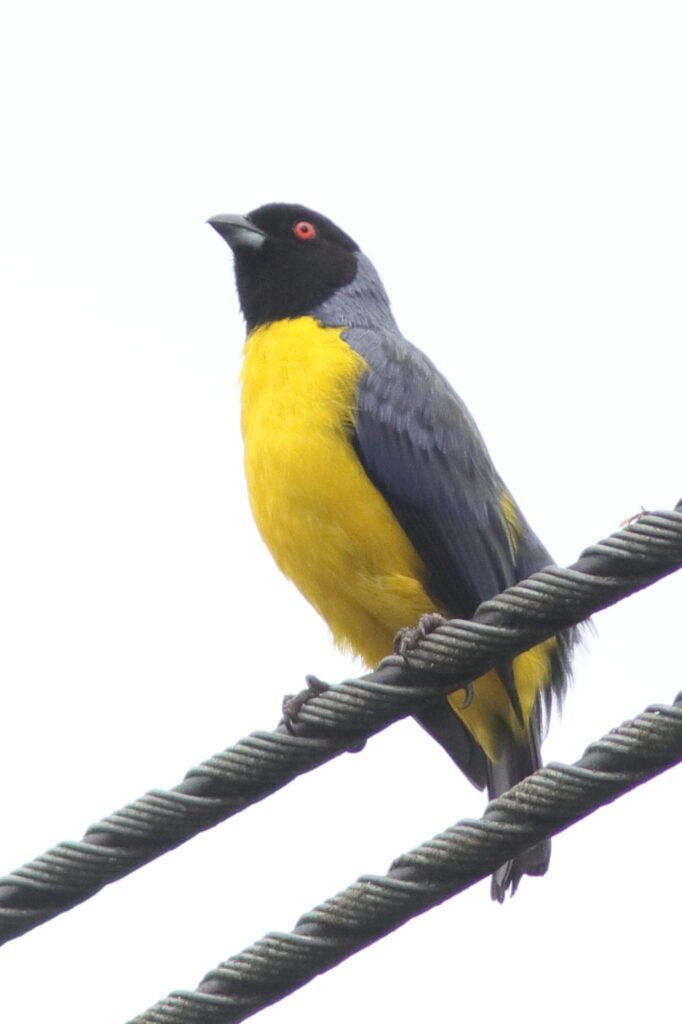
After lunch, we drove up to an overlook higher up in the mountain. Here we would find Hooded Mountain Tanager*, Lacrimose Mountain Tanager* Blue-and-black Tanager and hear a Grass-green Tanager.
The Mountain Tanagers really like the higher elevations. The well-named Hooded Mountain Tanager likes the elevation range between 5,700 and 10,500 on the east side of the Andes Mountains.
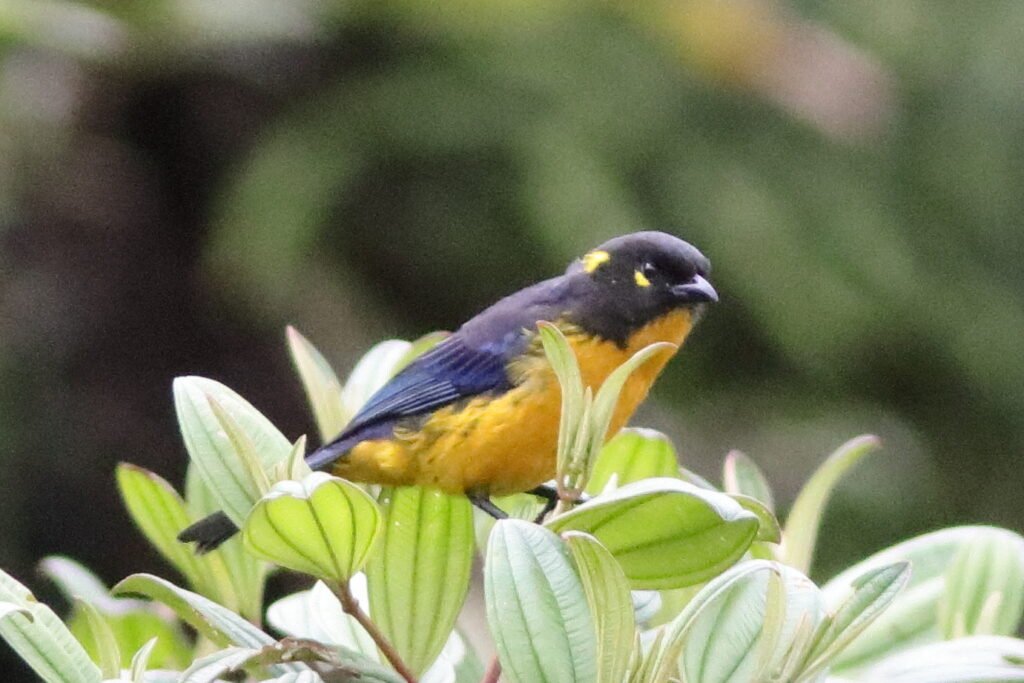
I admit I had to look up the word Lacrimose. It means “tearful, mournful, or causing tears.” Someone had fun naming the Lacrimose Mountain Tanager. The image shows the yellow “tear” just under the eye. They live between 6,300 and 9,900 feet above sea level. I know these sea level reports can be hard to relate to. Just remember, Denver sits at 5,300 feet and the highest city in the contiguous United States is Leadville, CO at 10,200 feet. Mount Whitney in California reaches 14,505 feet. These birds live the high life!
Our final day started at Cabana San Isidro with another early morning of birding where we found no tanagers and ended with a drive back up and over the mountains with just a single stop where we found our last tanagers, the Blue-gray-Tanager**, the Black-capped Tanager**, and the Saffron-crowned Tanager.
Hopefully, this gives you an idea of our itinerary. While I spent a lot of time talking about the different tanagers, this blog does not touch the vast number of birds we would find. Between the Galapagos Islands and Ecuador, we would find 453 species of birds, just a small percentage of the total number of birds one can find in Ecuador. We were all glad we had such skilled and friendly local guides. I cannot imagine how we could have managed without them.
Written by Bob Mercer
Photos by Bob Mercer