
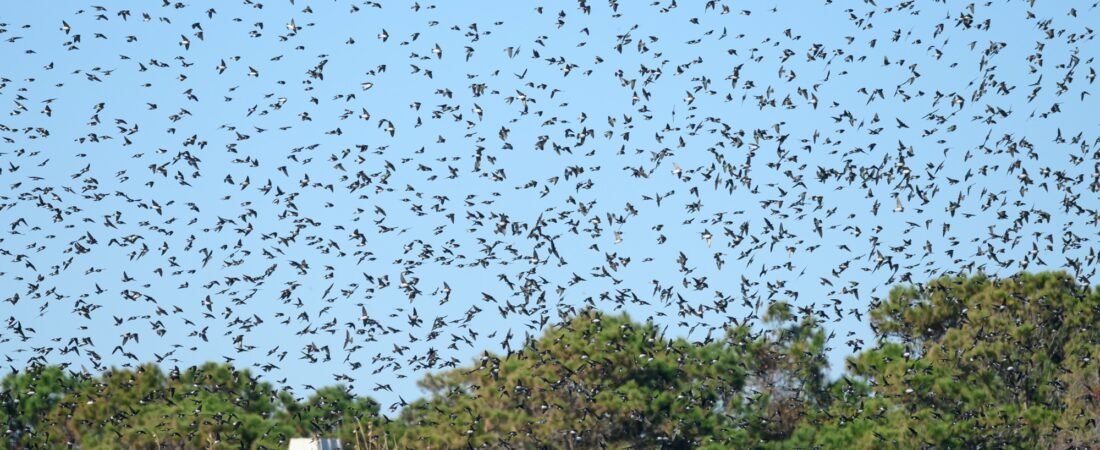
Have you ever noticed large flocks of small birds flying over our North Beach dunes in the fall? If so, you’ve likely seen Tree Swallows. Known for forming large flocks both on the sand and in the air, they winter in our area, but we see the highest numbers on Seabrook Island in October and November.
Tree Swallows are small, streamlined songbirds with long pointed wings and a short, squared, slightly notched tail. Adult males are iridescent blue above and clean white below with blackish flight feathers and a thin black eye mask; females are duller with more brown in their upperparts, and juveniles are completely brown above. Juveniles and some females can show a weak, blurry gray-brown breast band.


Tree Swallows fly acrobatically, twisting and turning, chasing insects in mid-air. Insects are their primary diet, but they also eat mollusks, spiders, fruit, berries, and seeds. Tree Swallows gather in large flocks to migrate. In the non-breeding season, they form huge communal roosts, numbering in the hundreds of thousands. They form a dense cloud above a roost site, swirl around like a tornado, and with each pass birds drop down until all are settled on the roost.
Tree Swallows nest either in isolated pairs or loose groups, in both natural and artificial cavities. The nest cup itself is made from grass, moss, pine needles, and aquatic plants collected mostly by the female and is lined with feathers gathered primarily by the male in fights. The feathers may function to insulate the nest, decreasing incubation time. The female incubates the clutch of 2 to 8 (but usually 4 to 7) pure white eggs for around 14 to 15 days. The chicks hatch blind, helpless, and sparsely covered with down. They generally fledge about 18 to 22 days after hatching.
This range map shows that Tree Swallows breed in the United States and Canada. They winter along southern US coasts, along the Gulf Coast, to Panama and the northwestern coast of South America, and in the West Indies.

According to Partners in Flight, the total breeding population size of the Tree swallow is estimated at 20,000,000 birds, and is classified as a species of low conservation concern.
Source: The Cornell Lab of Ornithology
Feature image by Gina Sanders
Leave a Reply