
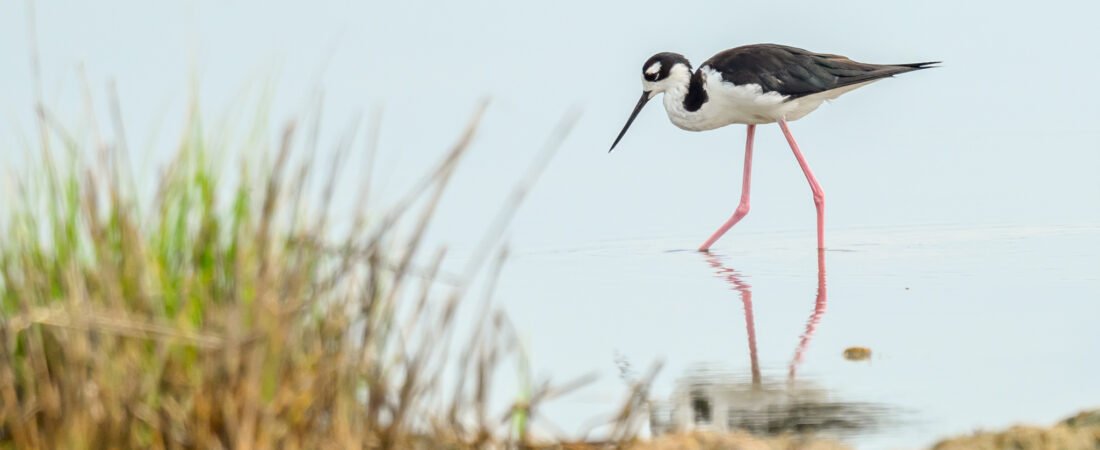
Black-necked Stilts are not commonly seen on Seabrook Island. A search in eBird finds two were spotted on North Beach in May, 2025, but no reports have been recorded on Seabrook Island for 2026. However, they are found in marshes around the Charleston area, and if you look in eBird under “Explore Species” or “Explore Hotspots” you can see exactly where you might find these elegant shorebirds.
They’re in our area mainly in the April-September time frame, for their breeding season. And like many birds, head to Central and South America for the winter months.
One of the most notable features of Black-necked Stilts is their long, pink legs. They’re elegant shorebirds, with those pink legs, long, thin black bill, and stately black and while plumage helping them stand out.
They’re constantly on the move through mudflats, saltmarshes, flooded fields, or salt pans. They move deliberately when foraging, walking slowly through wetlands in search of tiny aquatic prey. In fact, during an impromptu outing recently, a few SIB members were excited to see 15 stilts mixed in with Great Egrets and Snowy Egrets. This video shows them in constant motion, taking only short breaks to preen and rest.
Their diet consists of aquatic invertebrates, small crustaceans, amphibians, snails, and tiny fish. They prey on larval mosquitoes, soldier flies, brine flies, caddisflies, dragonflies, mayflies, crickets, grasshoppers, many kinds of beetles, water-boatmen, crayfish, brine shrimp, tadpoles, and very small frogs and fish. These are captured with a quick peck, sometimes with the head partly submerged. Sometimes, they swing the bill side to side in the water, much as avocets do, to skim invertebrates from the surface or just below the surface. Seeds and vegetation also form a tiny part of their diet.
Black-necked Stilts nest on the ground. They tend to build on surfaces above water, such as small islands, clumps of vegetation, or even, occasionally, floating mats of algae. Both female and male choose the site; they look for places with soft sand or other substrate that can be scraped away to form the nesting depression. Males and females share the work of nest construction. While one observes, the other scrapes into the dirt with breast and feet to form a depression about 2 inches deep. As they dig, they add small bits of lining back into the nest. Most lining is added to the nest during incubation and consists of whatever material is closest to the nest, including grasses, shells, mud chips, pebbles, and bones. Some nests are left unlined. Clutch sizes are 2-5 eggs and they have one brood per year. Hatchlings are covered with down and able to run awkwardly within two hours of hatching.
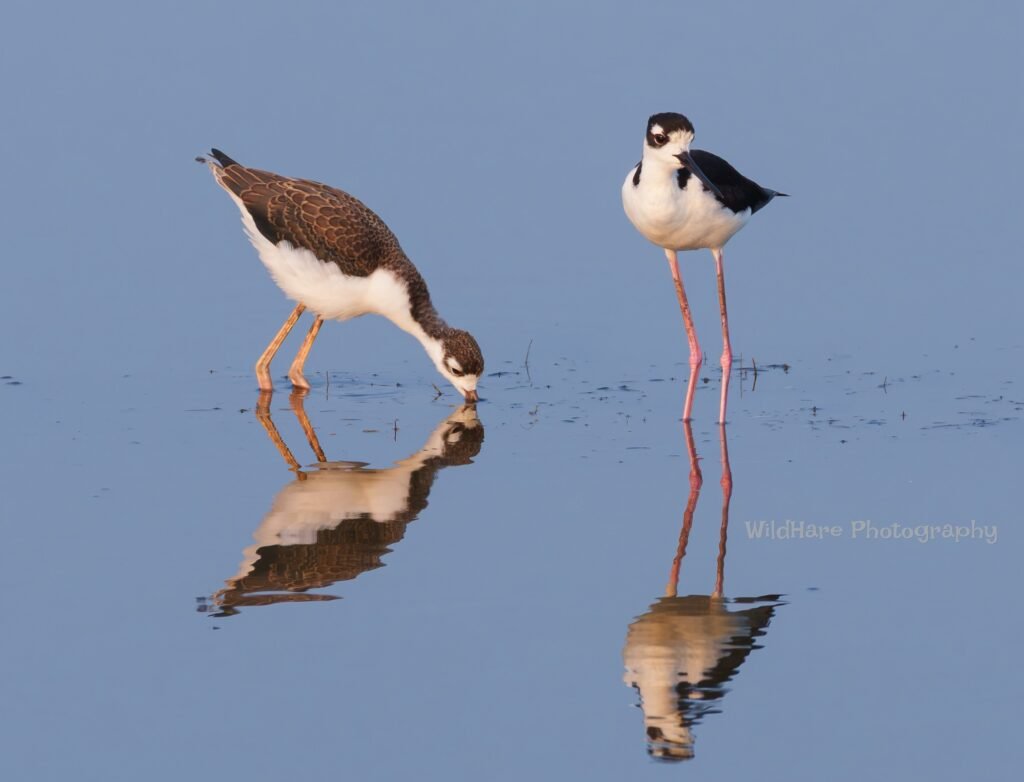
Black-necked Stilt populations have been stable between 1966 and 2015 in continental North America, according to the North American Breeding Bird Survey. Because stilts are wetland birds, they are vulnerable to wetland destruction, degradation, and especially pollution, including pesticides, heavy metals, and other elements such as selenium.
The oldest recorded Black-necked Stilt was at least 12 years, 5 months old. It was banded in Venezuela and seen again in the Lesser Antilles.
Source: Cornell Lab of Ornithology, eBird and All About Birds
Feature Image: Gina Sanders