
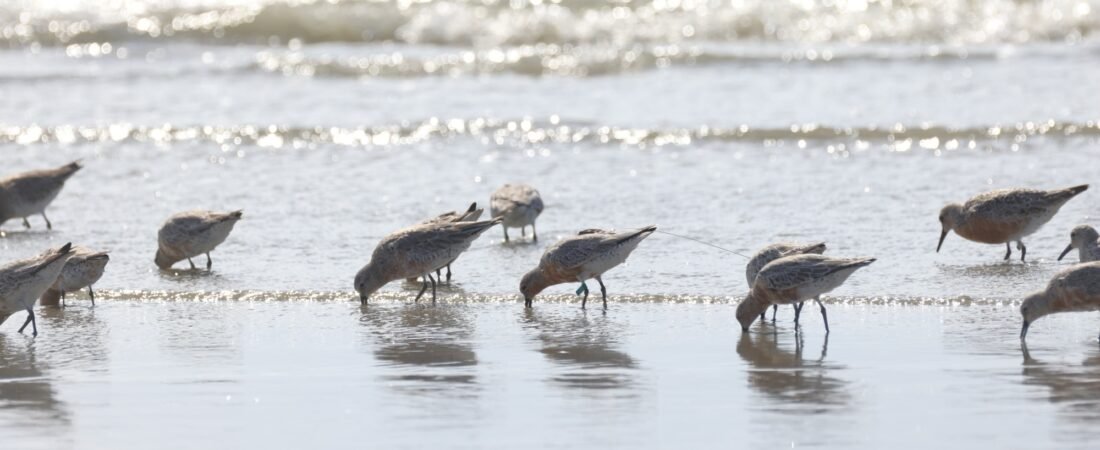
Breeding season has come and gone in the Canadian Arctic, and our Red Knots have made significant headway on their southern migration! We are eager to share some exciting southbound migrations with you, but first, let’s take a look at where the 2026 cohort dispersed across the Arctic to breed.
We’ve documented 12 breeding site locations! Here’s how they are distributed: 7 on King William Island (all on separate territories), 2 on Victoria Island, 1 on Prince of Wales Island, 1 on Southampton Island, and 1 on Prince Charles Island. Check out the map below to see how widely distributed these breeding sites are across the Canadian Arctic!

By now, some of these transmitters have fallen off; however, we still have eight Red Knots actively transmitting their locations.
Deployed on Kiawah Island, SC 4/18/2026:
| 5L* | KC2 | LX2 |
Deployed in Cape Romain NWR, SC 5/17/2026:
| KP0 | KP5 | KP9 | KP1 | KL0 |
We currently have five individuals already on the north coast of South America, including three in Venezuela, one in French Guiana, and one in Brazil.
In Venezuela, KL0 and KP5 appear to be in the same flock in Los Olivitos Wildlife Refuge and Fishing Reserve, yet these two birds had different arrival dates and southbound tracks.
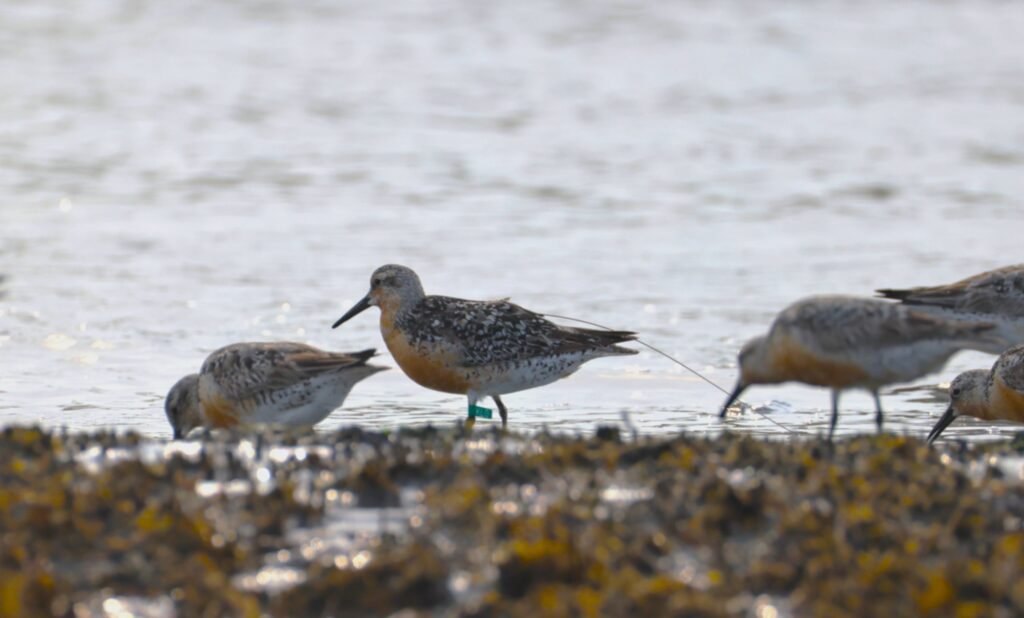
KL0 was the first of this cohort to leave the breeding grounds, on July 6. After spending a couple of days on the western shores of James Bay, Canada, KL0 continued southeast, hugging the Atlantic coast of the US before stopping in Cape Romain National Wildlife Refuge for 10 days. This gave our team a chance to resight this bird, not too far from where we had originally captured it earlier in May! It continued its journey south and arrived in Venezuela on August 4.
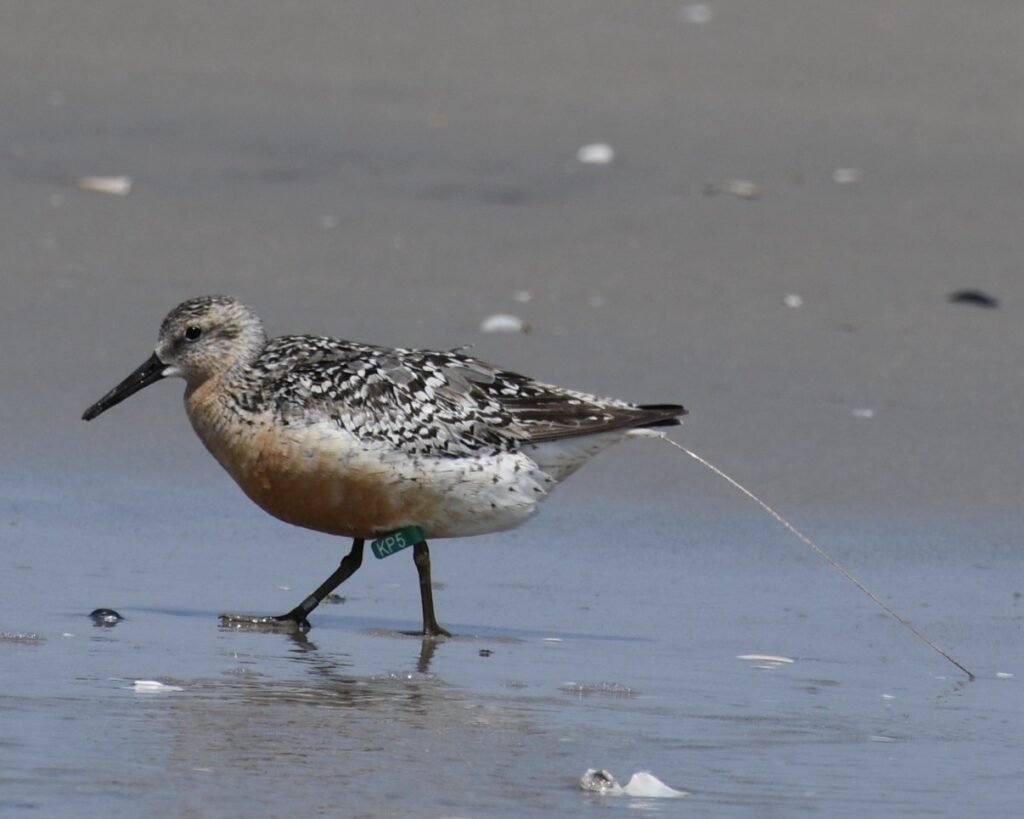
KP5 left the breeding grounds on July 19 and spent roughly two weeks on the western shores of Hudson Bay, Canada, before starting the next leg of its journey. It then spent six days around Stone Point Harbor, NJ, during which John Kauterman sighted it and shared photos with us (see online update). We are glad to see the knots with transmitters appear to be plump and healthy. On August 15, it left the New Jersey coast and headed straight south towards Venezuela.
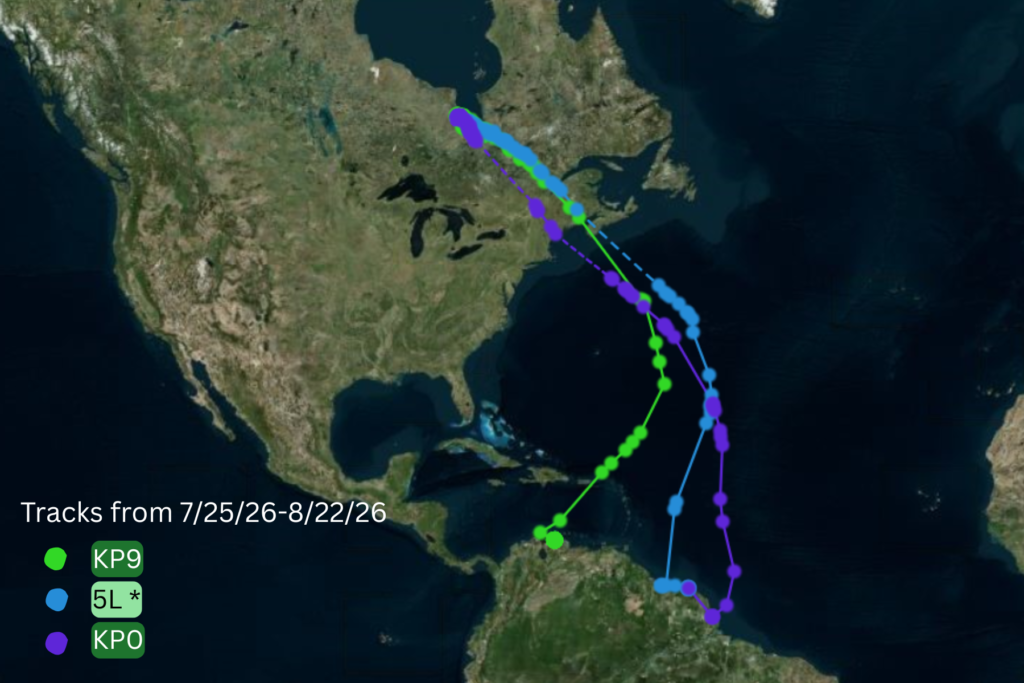
While both KL0 and KP5 took a near-shore flight path along the United States and through the Caribbean, the other three individuals currently in South America, 5L*, KP0, and KP9, had a different strategy. All three departed directly from James Bay, Canada, and headed southeast towards the Gulf of Maine, undertaking a multi-day open-ocean flight over the Atlantic before landing on the north coast of South America, 4 to 5 days later. Below are their trajectories:
We also have two individuals in the Caribbean region, LX2 and LY1. LY1 arrived on Andros Island in the Bahamas on July 30, although its tag stopped emitting shortly after. LX2 is still actively tracking on the north coast of Cuba, where it arrived on August 17 and has been spending time around Cayo Romano, in the Jardines del Rey archipelago. This is the fifth individual that we have documented visiting the island since we started deploying satellite tags in 2023!
KP1 is our northernmost tracked individual. After departing from breeding grounds on August 2 and spending just a few days along Hudson Bay, Canada, KP1 arrived in Cape Romain National Wildlife Refuge on August 15, where it has been ever since. This is the third individual to come back to the Southeast this year. Interestingly, this bird is using the same localized area that KL0 used only a couple of weeks earlier.
Finally, KC2 is actively flying south just southeast of the Lesser Antilles and appears to be heading towards the Venezuela coast. Perhaps it will join KL0 and KP5 at Los Olivitos?! After breeding on Prince Charles Island, this individual made use of a network of small rocky islands in Mingan Archipelago National Park, Canada for nearly 2 weeks. According to Yves Aubry, a biologist with Canadian Wildlife Service, the arrival timing of this individual at that site indicates that it is likely a male that successfully raised chicks!
Where will they go next? Stay tuned for the next update!
As a reminder, this project is a collaboration between the South Carolina Department of Natural Resources, Georgia Department of Natural Resources, Manomet Conservation Sciences, the U.S. Fish and Wildlife Service, and the South Carolina Cooperative Fish and Wildlife Research Unit at Clemson University.
You can read more about this partnership and explore past updates here.
Written by Cami Duquet, SC Department of Natural Resources.
Images provided by SC Department of Natural Resources.
Reprinted with permission.
Leave a Reply