

Royal Terns are often among the first birds a visitor sees at Seabrook Island’s North Beach, along with species such as Laughing Gulls and Brown Pelicans. They fly gracefully and slowly along the coastline, diving for small fish, which they capture with a swift strike of their daggerlike bills. Royal Terns live up to their regal name with a tangerine-colored bill and ragged, ink-black crest against crisp white plumage. In late summer and fall, Royal Terns lose most of their black crest and sport a white forehead.
Among the many species of terns at North American beaches, Royal Terns are among the largest, outsized only by the Caspian Tern.
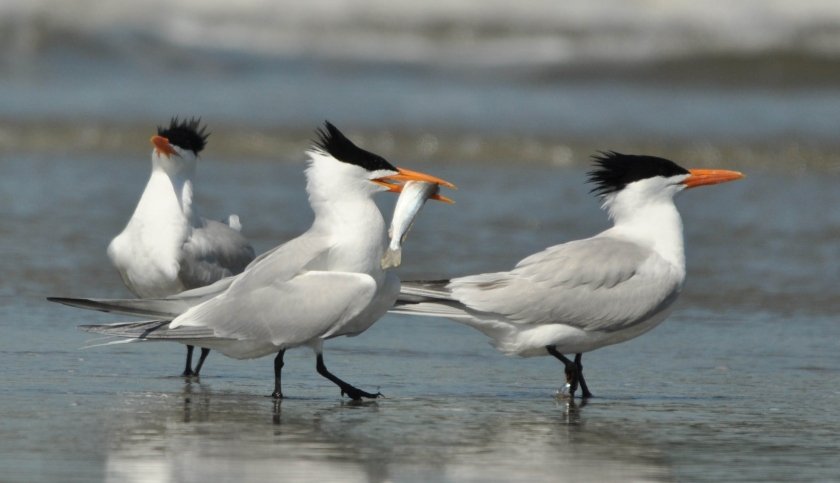
Aside from their tangerine colored bill, listening for their distinctive call (ka-rreet!) is a good way to identify Royal Terns. Click here to hear the sounds of a Royal Tern. As mentioned, the Caspian Tern is larger, but can be indentified by its red bill and raspier sound. For comparison, click here to hear the Caspian Tern.
Royal Terns eat mostly small (2–4-inch) fish and shrimp, which they capture by flying 20–30 feet above the water and plunge-diving to seize prey in the bill. After capturing a prey item near the water’s surface, they rise up quickly and continue flying, usually swallowing the item while in flight, sometimes after manipulating it in the bill to soften it. Royal Terns eat many types of small, surface-schooling fish, including silverside minnows, anchovies, sardines, menhaden, bluefish, butterfish, and drum.
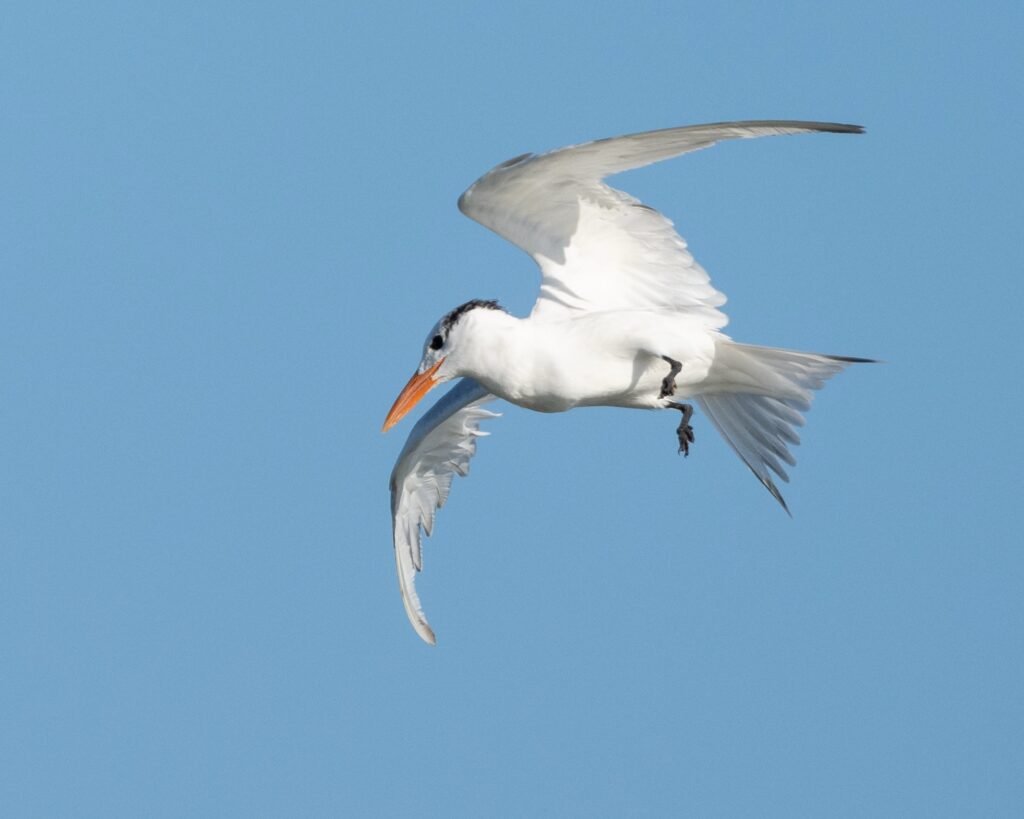
Royal Terns nest in dense colonies. They tolerate others of their species except during the height of courtship, when males are prone to squabbling with each other. Like other terns, Royals court both in the air and on the ground. In the air, male and female make high, spiraling flights, with the male often giving the female a fish in midair, with much calling. On land, males present interested females with a small fish, crab, or shrimp, while calling, then bow to the females, raising the crest. Once paired, the two come close together, head to tail, and begin to walk in a tight circle together, then often strut side by side through the colony.
Like many other shorebirds and seabirds, their nests are small, unlined depressions in the sand, made by digging with the feet and finishing the shape with the belly. Clutch sizes are 1-2 eggs and they have one brood. At hatching, their eyes are open, they’re covered with down, and able to leave the nest within one day.

Like many tern species, Royal Terns in their colonies perform a group behavior that is called a “dread” or a “panic.” Virtually all the breeding birds in the colony rise up slowly and fly together in silence over the colony site for up to 20 minutes. These flights typically happen early during colony formation, but it’s not known why. Normally, Royal Tern colonies are very noisy places, even at night.
Royal Terns are very sensitive to disturbance at nesting colonies and may abandon them if people, dogs, or predators approach too closely. As human populations grow and gather on beaches in increasing numbers, colony disturbance can become a serious problem. Some colonies that once occupied barrier island beaches have moved to artificial dredge-spoil islands for nesting, but these too have attracted humans and their pets in recent years. A separate concern is the erosion and loss of coastal islands to rising sea levels, which further limit potential nesting areas for this species. Climate change, with increasingly frequent and more destructive tropical storms, is likely to threaten this species and many other seabirds.
Source: Cornell Lab All About Birds
Feature Image: Royal Tern, Bonaire – Gina Sanders
Leave a Reply