
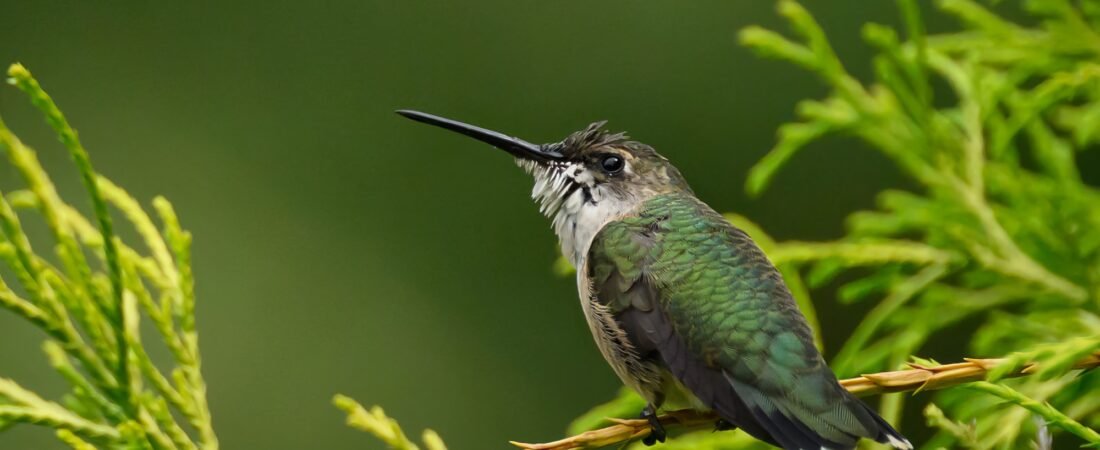
The Ruby-throated Hummingbird is a familiar sight here on Seabrook Island, and all up and down the east coast. It’s the only hummingbird in the eastern half of the United States, unless a stray migrant happens to be passing through. Out of the roughly 365 known hummingbird species in the world, about 15-18 species regularly nest and spend their summers in the United States.
The male Ruby-throated Hummingbird has the namesake bright red throat, females do not. Immature males will have some red feathers on their throat.


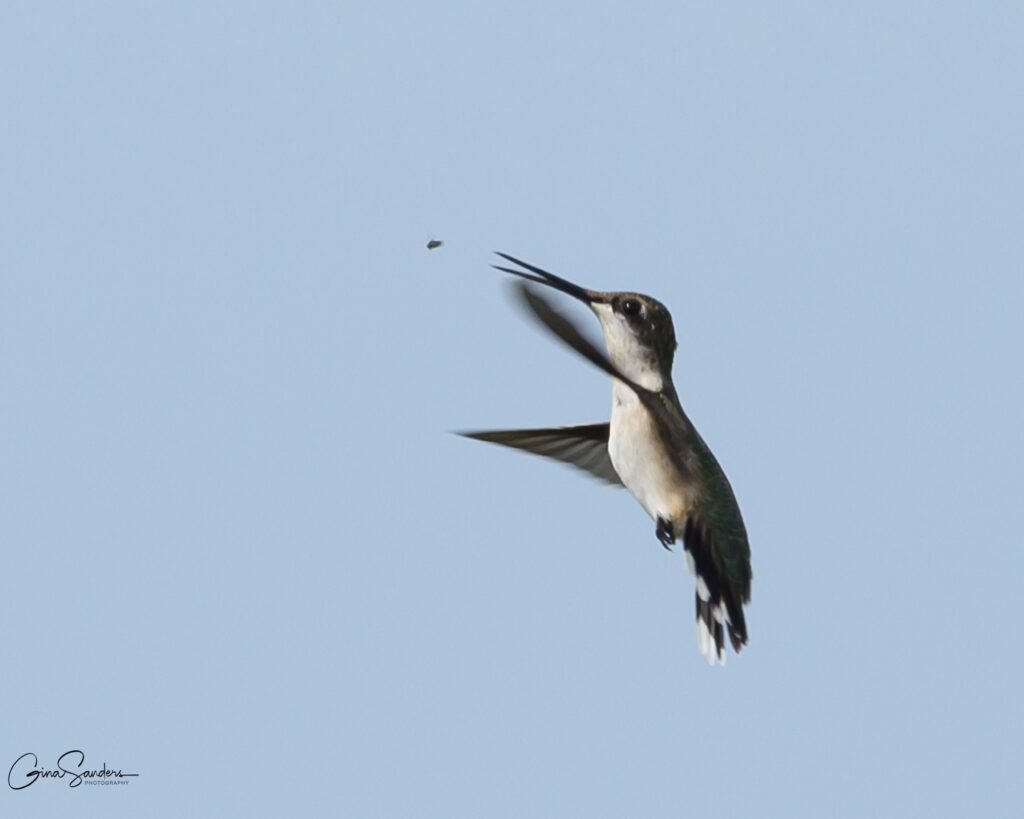
Ruby-throated Hummingbirds feed on the nectar of red or orange tubular flowers such as trumpet creeper, cardinal flower, honeysuckle, jewelweed, bee-balm, red buckeye and red morning glory, as well as at hummingbird feeders and, sometimes, tree sap. Hummingbirds also catch insects in midair or pull them out of spider webs. Main insect prey includes mosquitoes, gnats, fruit flies, and small bees; also eats spiders. Ruby-throated Hummingbirds sometimes take insects attracted to sap wells or picks small caterpillars and aphids from leaves.
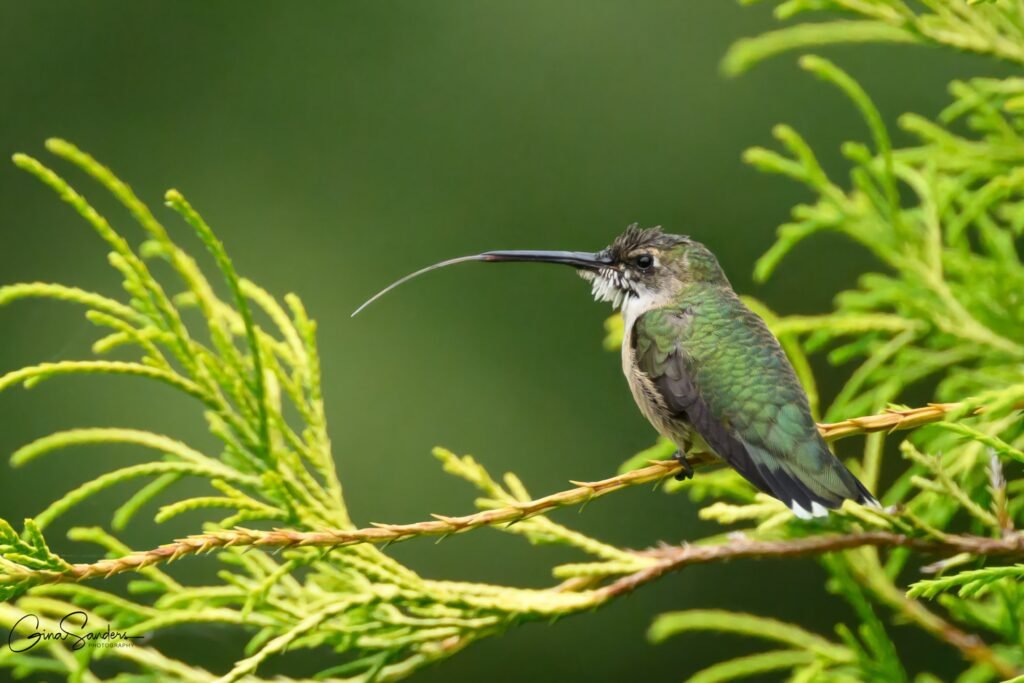
You can attract Ruby-throated Hummingbirds to your backyard by setting up hummingbird feeders or by planting tubular flowers. Make sugar water mixtures with about one-quarter cup of sugar per cup of water. Food coloring is unnecessary; table sugar is the best choice. Change the water before it grows cloudy or discolored and remember that during hot weather, sugar water ferments rapidly to produce toxic alcohol, so best to change it daily.
You may have noticed their courtship ritual in spring. Males give a courtship display to females that enter their territory, making a looping, U-shaped dive starting from as high as 50 feet above the female. If the female perches, the male shifts to making fast side-to-side flights while facing her.
Females build their nests on a slender, often descending branch, usually of deciduous trees like oak, birch, poplar, or hackberry; sometimes pine. Nests are usually 10-40 feet above the ground. Nests have even been found on loops of chain, wire, and extension cords!
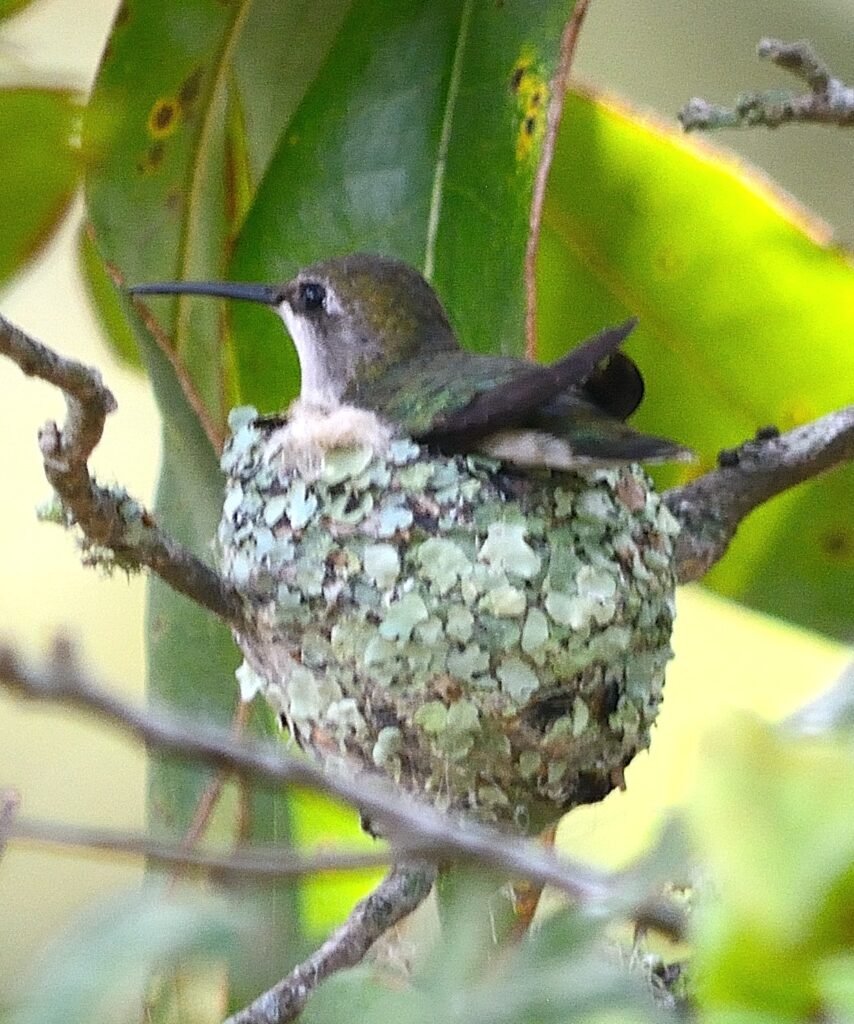
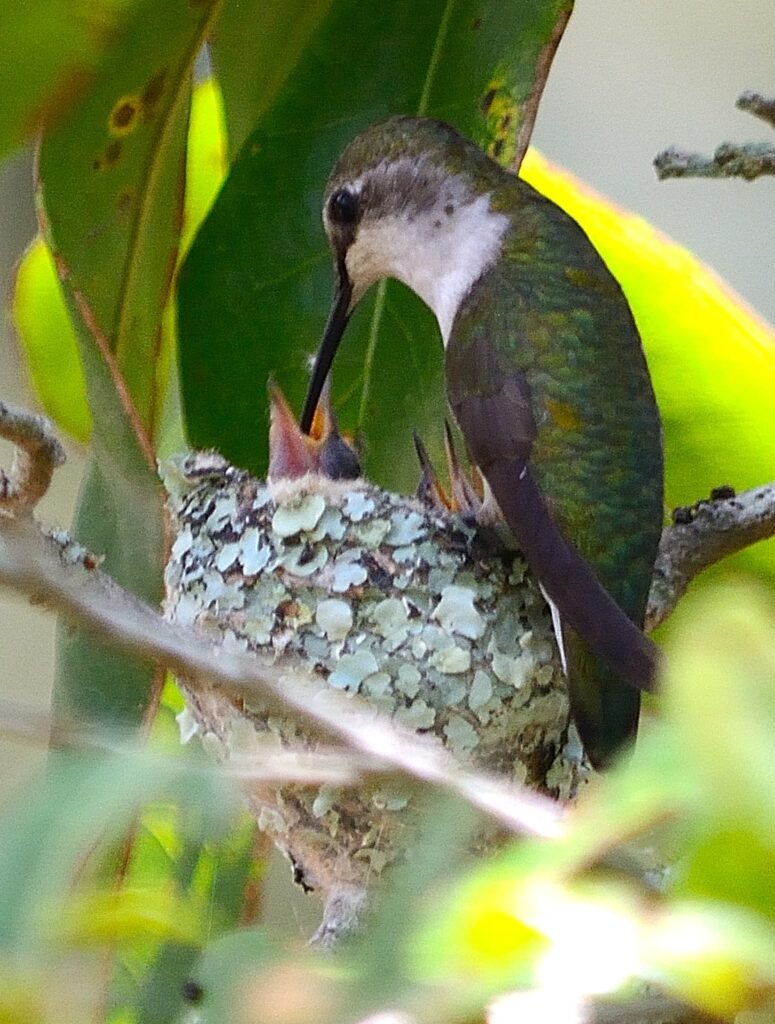
The nest takes 6-10 days to finish and measures about 2 inches across and 1 inch deep with the inner cup about the size of a large thimble. The nest is built directly on top of the branch rather than in a fork. It’s made of thistle or dandelion down, held together with strands of spider silk and sometimes pine resin. The female stamps on the base of the nest to stiffen it, but the walls remain pliable, allowing it to stretch as the chicks grow. She shapes the rim of the nest by pressing and smoothing it between her neck and chest. The exterior of the nest is camouflaged with bits of lichen and moss.
Hummingbirds lay 1-3 tiny eggs, about the size of a Tic Tac, and can have 1 or 2 broods in a season. Females incubate for 2 weeks and nestlings stay in the nest about 3 weeks before fledging. The male has no part in the nest construction, care, or feeding of nestlings – these jobs are left entirely to the female.
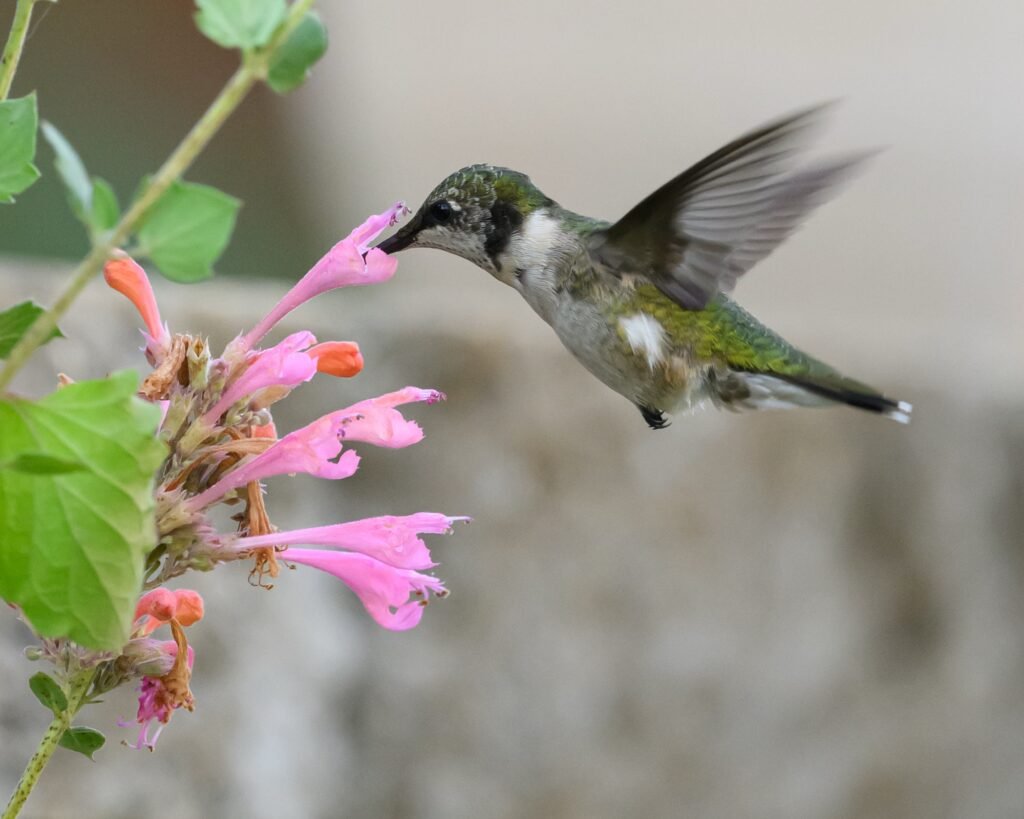
Like all hummingbirds, ruby-throats are precision flyers with the ability to fly full out and stop in an instant, hang motionless in midair, and adjust their position up, down, sideways, and backwards with minute control. They dart between nectar sources with fast, straight flights or sit on a small twig keeping a lookout, bill waving back and forth as the bird looks around. Male Ruby-throated Hummingbirds aggressively defend flowers and feeders, leading to spectacular chases and dogfights, and occasional jabs with the beak.
Some interesting facts about Ruby-throated Hummingbirds:
- Their wings beat about 53 times per second!
- Their extremely short legs prevent them from walking or hopping. The best they can do is shuffle along a perch. Nevertheless, they can scratch their head and neck by raising their foot up and over their wing.
- Male Ruby-throated Hummingbirds don’t stick around long. Pairs are together long enough for courtship and mating – just a matter of days to weeks. Then he’s off on his own, and may begin migration by early August.
- The oldest known Ruby-throated Hummingbird was a female, and at least 9 years, 2 months old when she was recaptured and rereleased in 2014 during banding operations in West Virginia.
If you’d like to read more about Ruby-throated Hummingbirds, check out our blog about their amazing flight capabilities!
Source: Cornell Lab All About Birds